April 5, 2026
Mining Data Centers: Ruggedized Modular Solutions for Remote Sites
Mining data centers process terabytes from autonomous fleets at -35°C to +55°C. IP65, MIL-STD-810H specs, 3–6 month deploy.
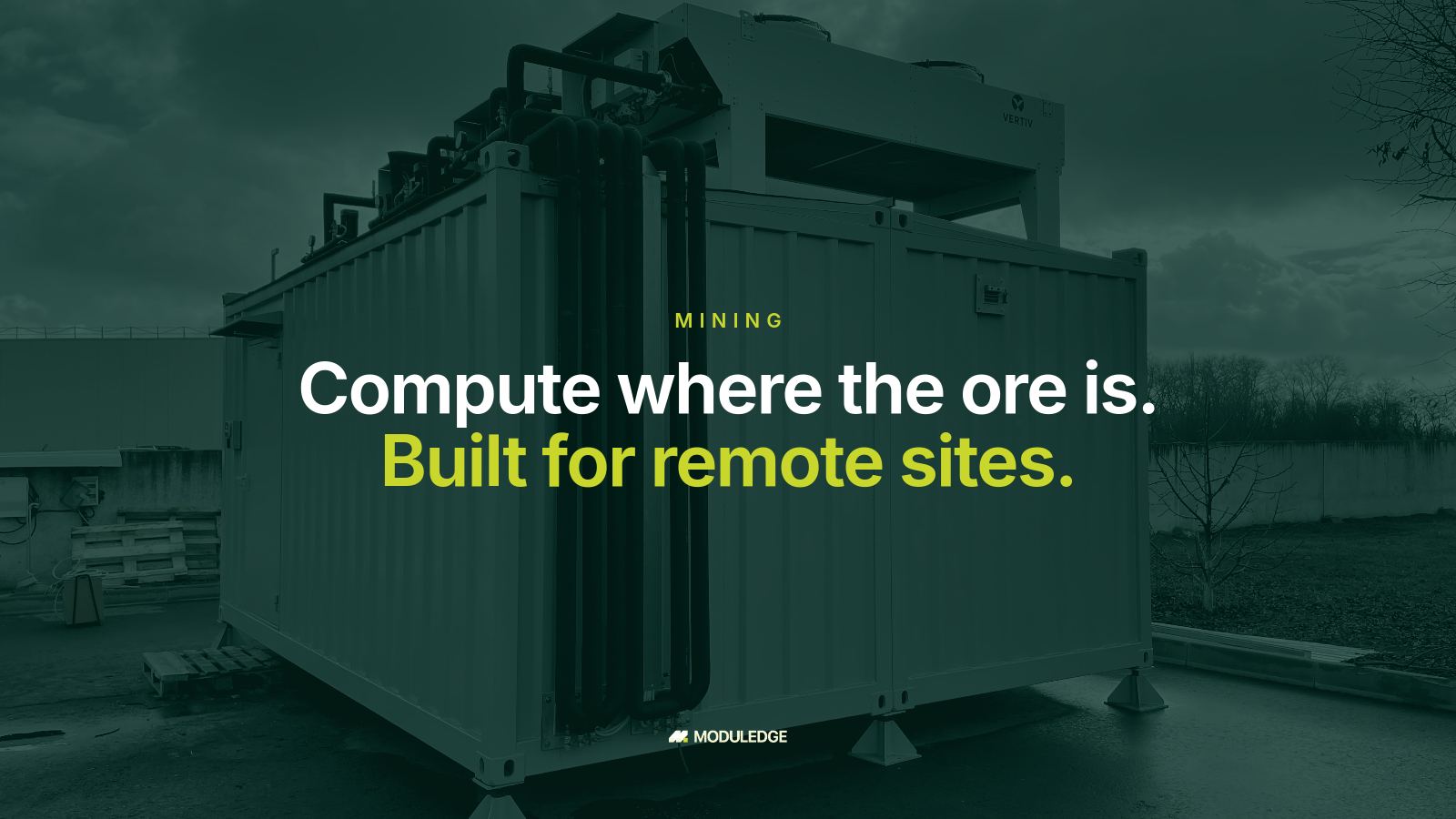
A mining data center is a ruggedized, self-contained computing facility designed to operate at or near a mine site, providing the low-latency processing that autonomous vehicles, predictive maintenance systems, and real-time ore analysis require. Unlike standard commercial data centers that operate within ASHRAE's recommended 18–27°C envelope, mining data centers must function across ambient temperatures from -40°C to +55°C, withstand dust concentrations exceeding 19,000 µg/m³, tolerate blast vibrations up to 50 mm/s PPV, and run on off-grid diesel or hybrid power. With over 3,800 autonomous haul trucks now operating at surface mines worldwide (GlobalData, July 2025) and unplanned equipment downtime costing the industry an estimated $15 billion annually (GlobalData/Innovapptive), the case for on-site compute in mining has shifted from theoretical to operational.
This post covers why mining operations need on-site compute, the environmental challenges that rule out standard IT infrastructure, how off-grid power shapes data center design, what ruggedized specifications actually mean in practice, and why factory-built modular data centers solve problems that traditional construction cannot.
Why Mines Need Computing at the Pit Face
The modern mine generates more data than it can transmit. A single autonomous haul truck carries over 200 sensors monitoring engine temperature, hydraulic pressure, vibration frequency, tire wear, and fuel consumption. Caterpillar's MineStar Command LiDAR fires 64 Class 1 lasers over one million times per second to build 3D point clouds of the operating environment. Multiply that by a fleet of 50 or 100 trucks, add in drill rigs, excavators, and conveyors, and you're looking at terabytes of data per day from a single operation.
That data cannot wait for a round trip to the cloud. Safe autonomous operation requires 50–100 milliseconds end-to-end latency for the core driving loop (Driveblocks.ai, 2022). Collision avoidance systems like Hexagon MineProtect need to detect and respond to proximity threats within 500 meters at any speed. GEO satellite links deliver roughly 600–3,000 milliseconds of latency. Even Starlink's LEO constellation manages only 30–60 ms under ideal conditions, with weather and terrain degrading performance further. For a 300-tonne haul truck traveling at 40 km/h, the difference between 50 ms and 600 ms of latency is the difference between a controlled stop and a catastrophic collision.
The scale of autonomous mining is no longer small. Komatsu's FrontRunner system operates 750+ trucks across 23 mine sites in five countries, having hauled over 10 billion metric tons cumulatively. Caterpillar's Command fleet reached 690 trucks by end-2024, with a stated target of 2,000+ by 2030. In China alone, EACON has deployed 2,000+ OEM-agnostic autonomous trucks. Caterpillar's autonomous fleet has recorded zero lost-time injuries since 2013, across 147 million kilometers driven. That safety record depends entirely on sub-100 ms compute loops running locally, not in a data center 1,000 km away.
Predictive maintenance: the cost argument
Beyond autonomous driving, predictive maintenance makes the financial case for on-site compute almost self-evident. Ultra-class haul truck downtime costs $5,000–$20,000 per hour (HVI Mining Fleet Management Guide, 2026). Major breakdowns can reach $2 million per day. An engine rebuild on a single large haul truck runs approximately $400,000. Large mining operations lose roughly $59 million per year to unplanned downtime.
Real-time vibration analysis, thermal imaging, and oil analysis can catch failures before they happen, but only if the data is processed locally with millisecond response times. An Arizona copper mine (215 units) that deployed on-site predictive maintenance achieved a 42% reduction in unplanned downtime and $3.2 million in annual savings, with 352% ROI and a 3.4-month payback (HVI). McKinsey estimates predictive maintenance reduces maintenance costs by 18–25% versus preventive approaches and up to 40% versus reactive ones (McKinsey, 2020–2023).
AI-powered ore sorting
Edge compute is also transforming ore processing. AI-powered sorting systems using dual-energy X-ray machines can reject waste rock in real time, enriching ore grades significantly. At the Fankou lead-zinc mine in China, an AI sorting system rejects over 105,000 tonnes of waste rock per year, enriching ore grades from 3% to 12–14% (Mine Magazine, February 2025). Freeport-McMoRan's AI models have improved metal recovery and increased throughput by 10–15%. For a medium-sized mine processing 10,000 tonnes per day, the revenue uplift ranges from $25–50 million annually (Mine Magazine). These systems require real-time inference at the crusher face, not batch processing in a distant cloud.
The Environmental Gauntlet: Why Standard Data Centers Fail at Mine Sites
Mine sites span the planet's most extreme environments. The Pilbara region of Western Australia, where BHP, Rio Tinto, and Fortescue operate massive iron ore mines, recorded 50.7°C at Onslow in January 2022. Workers report that open-pit temperatures run approximately 10°C hotter than ambient, pushing effective temperatures above 60°C inside active pits. At the other extreme, Canada's Diavik Diamond Mine experiences wind chills of -55°C to -75°C in winter. Russia's Norilsk nickel operations see lows reaching -55°C, with snow cover for 250+ days per year.
That is a 100°C+ swing between the coldest and hottest mine sites on Earth. Standard ASHRAE A1 data center equipment allows just 15–32°C. Even the broadest ASHRAE class, A4, tops out at 5–45°C. Mining demands more.
Dust that kills electronics
The dust problem at mine sites is orders of magnitude worse than anything a standard data center faces. Measured PM10 levels at open-pit coal mines reach 426 µg/m³ near drilling equipment (PubMed, Haerwusu Surface Coal Mine study, 2018). Behind an operating haul truck, total suspended particulate peaks exceed 19,000 µg/m³ at 4 meters from the truck path (MDPI, 2025). For context, the WHO guideline for PM2.5 is 5 µg/m³ annual average. Mine dust levels routinely exceed safe human exposure limits by three to four orders of magnitude.
Particles under 2.5 µm penetrate standard enclosures, coat circuit boards, cause electrostatic discharge, corrode contacts, and thermally insulate components. Standard IP55-rated enclosures (dust-protected, not dust-tight) are insufficient. Mining environments require IP65 minimum: fully dust-tight with zero particle ingress per IEC 60529. IP66 adds high-pressure water jet resistance for equipment subject to washdown.
Vibration from blasting
Surface mine blasting generates peak particle velocities up to 50 mm/s at nearby structures, with frequencies of 1–300 Hz (Sonitus Systems). IT equipment is far more sensitive than building structures. Hard disk drives begin experiencing performance degradation at just 0.2 grms of random vibration (20–800 Hz), with complete write stall at 1.8 grms (Chan et al., Sigmetrics/GreenMetrics, 2013). SSDs show zero sensitivity to vibration in the same study, making them essential for mine-site deployments.
Altitude
High-altitude mines present cooling challenges that standard designs cannot address. The world's highest mines operate above 4,900 meters, where air density drops to roughly 60% of sea level. ASHRAE mandates derating maximum allowable temperature by 1°C per 300 meters above 900 m for A1/A2 equipment, 1°C per 175 m for A3, and 1°C per 125 m for A4 (ASHRAE TC 9.9, 2021). At a mine operating at 4,200 m like Chile's Collahuasi, the effective maximum temperature for A1 equipment drops from 32°C to roughly 21°C. Cooling systems must be oversized accordingly, and cable ampacity drops by 40–45% at these elevations (Feichun Cables, citing IEEE 835).
Off-Grid Power: The Constraint That Shapes Everything
Most remote mines operate entirely off-grid. GlobalData found that approximately half of the world's 10,000 mine sites have invested in on-site power infrastructure (Power Technology, 2024), with diesel gensets as the dominant technology. Energy costs represent approximately 30% of total cash operating costs for mining companies.
The economics are punishing. Diesel electricity generation at remote sites has a levelized cost of roughly $0.20–$0.40/kWh under moderate conditions (Thunder Said Energy), but in truly remote locations like the Canadian Arctic or West Africa, all-in costs reach $0.80–$1.00/kWh (Gletscher Energy). Canada's Diavik Diamond Mine cut diesel consumption by about four million litres a year after installing a wind farm, saving more than CAD $5 million annually (Nunatsiaq News). The mine's fuel was trucked 350 km over an ice road open for just two months each winter.
A mining data center adds relatively modest load to this power budget. A typical mine-site edge facility requires 50–200 kW of IT load across 5–10 cabinets. With a PUE of 1.3–1.5 in a well-designed sealed module, total facility power runs 65–300 kW. Against a mine that consumes 20–120 MW for operations, the data center represents less than 1% of site power, but delivers outsized returns through autonomous fleet efficiency gains (15% utilization improvement, per Rio Tinto), predictive maintenance savings (18–25% cost reduction), and ore sorting yield improvements (10–15% throughput increase).
Solar-hybrid microgrids are changing the power equation at some sites. Australia's Agnew Gold Mine operates a 56 MW hybrid microgrid with 18 MW wind, 4 MW solar, and 13 MW battery storage, achieving 50–60% renewable energy with 99.99% reliability (ARENA). Mali's Fekola Gold Mine commissioned a 30 MW solar array with 17.3 MW battery storage, covering up to 75% of daytime electricity and saving 13.1 million litres of heavy fuel oil per year. These installations reduce the marginal cost of powering on-site compute and improve the emissions profile.
What "Ruggedized" Actually Means in a Mining Data Center Spec
A ruggedized mining data center is not a shipping container with servers inside. It is a purpose-engineered facility that addresses every environmental threat simultaneously. Here is what the spec sheet needs to include, and why.
Operating temperature envelope: mining vs. standard data centers
| Parameter | Standard DC (ASHRAE A1) | Extended (ASHRAE A4) | Ruggedized Mining DC | MIL-STD-810H |
|---|---|---|---|---|
| Operating temp range | 15°C to 32°C | 5°C to 45°C | -35°C to +55°C | -51°C to +71°C |
| Max humidity | 80% RH | 90% RH | 95% RH (sealed) | Per Method 507.6 |
| Dust protection | Filtered air | Filtered air | IP65 dust-tight | Method 510.7 |
| Vibration tolerance | Minimal | Minimal | 5–25 G shock | Method 514.8 |
| Altitude (max standard) | 3,050 m | 3,050 m | 4,500 m+ with derating | Per deployment profile |
The -35°C to +55°C ambient operating range exceeds ASHRAE A4 at both ends. Achieving it requires active HVAC systems that maintain the internal environment within ASHRAE A2 or A3 limits while the outside temperature swings across a 90°C range. In practice, this means closed-loop direct expansion (DX) cooling with no outside air intake (to avoid dust contamination), electric resistance or glycol-loop heating for cold starts, anti-condensation systems for rapid temperature transitions, and oversized compressors for sustained high-ambient operation.
Ingress protection: the IP rating decision
| IP Rating | Dust Protection | Water Protection | Mining Suitability |
|---|---|---|---|
| IP55 | Dust-protected (limited ingress) | Low-pressure water jets | Insufficient for open-pit environments |
| IP65 | Dust-tight (zero ingress) | Low-pressure water jets | Minimum for mining operations |
| IP66 | Dust-tight (zero ingress) | Powerful water jets | Recommended for washdown areas |
| IP67 | Dust-tight (zero ingress) | Temporary immersion | For underground or flood-risk sites |
IP65 is the practical minimum for any mining data center deployed outdoors near active operations. The "6" first digit means complete dust-tightness per IEC 60529. Sealed enclosures eliminate the need for air-side economization and its associated filtration maintenance problems, which is a net positive in mining: no filter changes, no contamination risk, no maintenance access needed for air handling. The tradeoff is that all cooling must be closed-loop, which increases capital cost but dramatically reduces operational complexity at unmanned remote sites.
Vibration and shock
Mining enclosures should be tested to MIL-STD-810H Method 514.8 (vibration) and Method 516.8 (shock) profiles appropriate to the deployment environment. Key design practices include vibration-isolating mounts for all rack hardware, solid-state drives exclusively (no spinning disks), shock-mounted cable management, and structural reinforcement at all weld joints. Equipment near crushers and conveyors faces continuous vibration; equipment near blast zones faces intermittent high-amplitude shock. Both require different isolation strategies.
Cooling for extreme conditions
In sealed IP65+ enclosures, the standard approach is in-row DX cooling in N+1 redundancy. For extreme cold (below -20°C), systems must address condensation risk when transitioning from cold to warm states, freeze protection with glycol mixtures and heat tracing on any liquid loops, and pre-heating before IT equipment is powered on, with temperature change limited to 5°C per 15-minute period per ASHRAE guidelines.
For extreme heat (above 45°C), DX systems require larger condensers and oversized compressors. Hybrid approaches that combine dry cooling at night with DX assist during peak daytime heat can extend efficiency. In Arctic and sub-Arctic deployments, free cooling using the ambient cold is highly effective, but only when combined with dust-tight air-to-air heat exchangers that prevent contaminated outside air from contacting IT equipment.
Why Modular Beats Traditional Construction at Remote Mine Sites
Building anything at a remote mine site is expensive. Remote locations increase capital expenditure by 20–50% compared to projects near established infrastructure (Discovery Alert, 2025). A Mining Association of Canada study found that overall costs to explore and build new mines run up to 2.5x higher in remote northern Canada due to infrastructure deficits.
Traditional data center construction takes 18–24 months from concept to commissioning. At a remote mine, factor in limited transportation windows (ice roads open 8–10 weeks per year in the Canadian Arctic), shortage of skilled trades, extreme weather delays, and the logistics of shipping every component by barge, ice road, or aircraft. The timeline stretches further and costs compound.
Factory-built modular data centers solve this in three ways.
First, speed. Modules are manufactured in a controlled factory environment while site preparation (concrete pad, power connection, network cabling) happens in parallel. Total deployment time runs 3–6 months for custom configurations, versus 18+ months for traditional builds. This is a category advantage of the modular approach over stick-built construction at any remote site.
Second, predictability. Factory acceptance testing (FAT) verifies every system before the module ships. The module that arrives on site is the same module that was tested in the factory. There is no on-site integration risk, no weather delay during fit-out, and no coordination of a dozen subcontractors at a site with no local labor pool.
Third, redeployability. Gold mines operate 10–30 years. Copper mines run 5–70 years depending on the deposit. When a mine closes or operations shift, a traditional data center built on-site has near-zero salvage value. A modular data center built to ISO container dimensions can be disconnected, transported, and recommissioned at a new site. It is a capital asset that moves with the operation, not a sunk cost that gets demolished.
Mining companies are already making this shift. DXN Limited has delivered modular data centers to Anglo American's Capcoal mining complex in Queensland, Newcrest Mining's Cadia mine in NSW, Pilbara Minerals, and Covalent Lithium. NEXTDC's Port Hedland facility was purpose-built to support edge operations for mining and telecom in the Pilbara iron ore region.
Ruggedized Compute, Engineered for Your Mine Site
ModulEdge modules ship factory-tested with integrated power, cooling, fire suppression, monitoring, and security. Hardened for dust, vibration, and -35°C to +55°C extremes. Start with one module, scale as your fleet grows.
- Rack power from 5 to 150 kW, with cooling matched to site climate
- IP65 dust-tight enclosures with sealed-loop DX cooling
- Designed to meet Tier III/Tier IV principles
- Typical custom build cycles: 3 to 6 months
What to Do With This Information
If you are evaluating computing infrastructure for a remote mine site, whether for autonomous fleet management, predictive maintenance, ore sorting, or general operational IT, the specification conversation starts with environment, not with racks and servers. Define the ambient temperature range, dust exposure level, vibration profile, altitude, and power source first. Those parameters dictate the enclosure design, cooling architecture, IP rating, and power conditioning requirements. The IT fit-out follows from there.
FAQ
What is a mining data center?
A mining data center is a ruggedized, self-contained computing facility designed for deployment at or near a mine site. It houses the servers, networking equipment, and storage that support autonomous vehicle control, predictive maintenance, ore sorting, safety systems, and operational IT. Unlike standard data centers, mining data centers are engineered for extreme temperatures (-35°C to +55°C), heavy dust, vibration from blasting and heavy equipment, and off-grid power. They are typically built in ISO-standard container formats with IP65+ dust-tight enclosures and closed-loop cooling.
Why can't mining operations use cloud computing?
Cloud computing requires reliable, low-latency network connectivity that most mine sites lack. GEO satellite delivers 600+ ms latency, far above the 50–100 ms required for autonomous vehicle control and collision avoidance. Even LEO satellite (Starlink) achieves only 30–60 ms under ideal conditions. Autonomous haul trucks generate terabytes of data daily that cannot be uploaded over satellite links. Safety-critical systems like collision avoidance and emergency stop cannot tolerate network outages. Cloud works for non-time-critical analytics and reporting, but real-time operational computing must happen on site.
What IP rating does a mining data center need?
IP65 is the practical minimum for outdoor deployment at mine sites. The "6" means complete dust-tightness (zero particle ingress per IEC 60529), which is essential where dust concentrations behind haul trucks can exceed 19,000 µg/m³. IP55, which allows limited dust ingress, is insufficient for active mining environments. IP66 adds protection against powerful water jets and is recommended for sites subject to washdown or monsoon conditions. Underground mining in potentially explosive atmospheres may additionally require IECEx/ATEX compliance.
What temperature range should a mining data center support?
The operating temperature envelope depends on deployment region. Arctic mines (Canada, Scandinavia, Russia) require operation to at least -40°C. Desert mines (Pilbara, Atacama, Sahara) see ambient temperatures above 50°C, with in-pit effective temperatures 10°C higher. A design range of -35°C to +55°C covers the vast majority of global mining environments. The enclosure's HVAC system maintains internal conditions within ASHRAE A2 or A3 limits (10–40°C) while the external environment swings across this range.
How are mining data centers powered?
Most remote mining data centers run on the same diesel genset or hybrid microgrid power that supplies the rest of the mine. A typical mine-site edge facility requires 50–200 kW of IT load, representing less than 1% of a mine's total power consumption. Integrated UPS systems with lithium-ion batteries (preferred over lead-acid for temperature tolerance and weight) provide ride-through for power transitions. Solar-hybrid microgrids are increasingly common, with projects like Agnew Gold Mine achieving 50–60% renewable penetration with 99.99% reliability.
How long does it take to deploy a modular mining data center?
Factory-built modular data centers deploy in 3–6 months for custom configurations, compared to 18–24 months for traditional construction. The factory builds and tests the module while site preparation (concrete pad, power connection, network cabling) happens in parallel. On-site installation can be completed in days to weeks, depending on complexity. This speed advantage is particularly valuable at mine sites where construction windows may be limited by weather (e.g., Arctic ice road seasons of 8–10 weeks).
Can a mining data center be moved to another site?
Yes. Modular data centers built to ISO container dimensions (20ft or 40ft standard) can be disconnected from power and network, transported by road, rail, or sea, and recommissioned at a new site. This redeployability is a significant financial advantage in mining, where operations shift as deposits are exhausted. A modular data center is a capital asset that follows the mine, rather than a fixed structure that must be demolished at closure. Mine lifespans vary from 10 to 70 years depending on commodity and deposit size, making flexibility in infrastructure a practical necessity.
What role does a mining data center play in autonomous haulage?
Autonomous haulage systems from Caterpillar (Command), Komatsu (FrontRunner), and others rely on local compute for real-time perception processing, path planning, collision avoidance, and fleet coordination. The mining data center provides the low-latency edge computing that processes LiDAR, radar, and camera feeds within 50–100 ms. It also hosts the fleet management software, teleoperations systems for remote intervention, and the data analytics platform that optimizes routes, loads, and maintenance schedules. Over 3,800 autonomous surface mining trucks were operating globally as of mid-2025.
