February 15, 2026
Modular Data Center Cost: What Actually Moves CAPEX, OPEX, and Your Timeline
A framework for understanding modular data center pricing – and the five inputs you need before any quote makes sense.
A framework for understanding modular data center pricing – and the five inputs you need before any quote makes sense.
Here's the uncomfortable truth about modular data center cost: there isn't one.
Not a single number. Not even a reliable range without knowing your power requirement, site status, redundancy tier, and when you need it live. The vendors who quote you €X per kW without those inputs are either guessing or selling you something that won't match what you actually need.
This piece breaks down the cost drivers that actually move the needle – on CAPEX, on OPEX, and on timeline. By the end, you'll know what questions to ask before engaging any modular data center supplier, and you'll be able to spot the quotes that are noise versus the ones worth your time.
The Baseline: What Published Benchmarks Actually Tell You
Let's start with what we can anchor to. A 2025 US development cost guide from Cushman & Wakefield reports facility construction costs clustering around $9.3M–$15.0M per MW of critical load across major US markets, with an average near $11.7M/MW. This excludes owner-furnished items and tenant costs – so it's a construction-oriented view, not total project cost.
A separate quantitative analysis from Schneider Electric comparing a 440 kW Tier III traditional build versus prefabricated approach found rough cost neutrality – about 2% lower CAPEX for the prefab reference design, coming in around $5.39M for 440 kW (approximately $12.3M/MW in that scenario).
The takeaway: modular data center construction is frequently cost-competitive with traditional builds, but it's not automatically cheaper. Savings in on-site labor and building shell get offset by higher factory-integrated materials and housings. The real question isn't "is modular cheaper?" It's "where does modular shift the cost and risk in ways that matter for your project?"
To understand where costs concentrate, look at how traditional data center development breaks down:
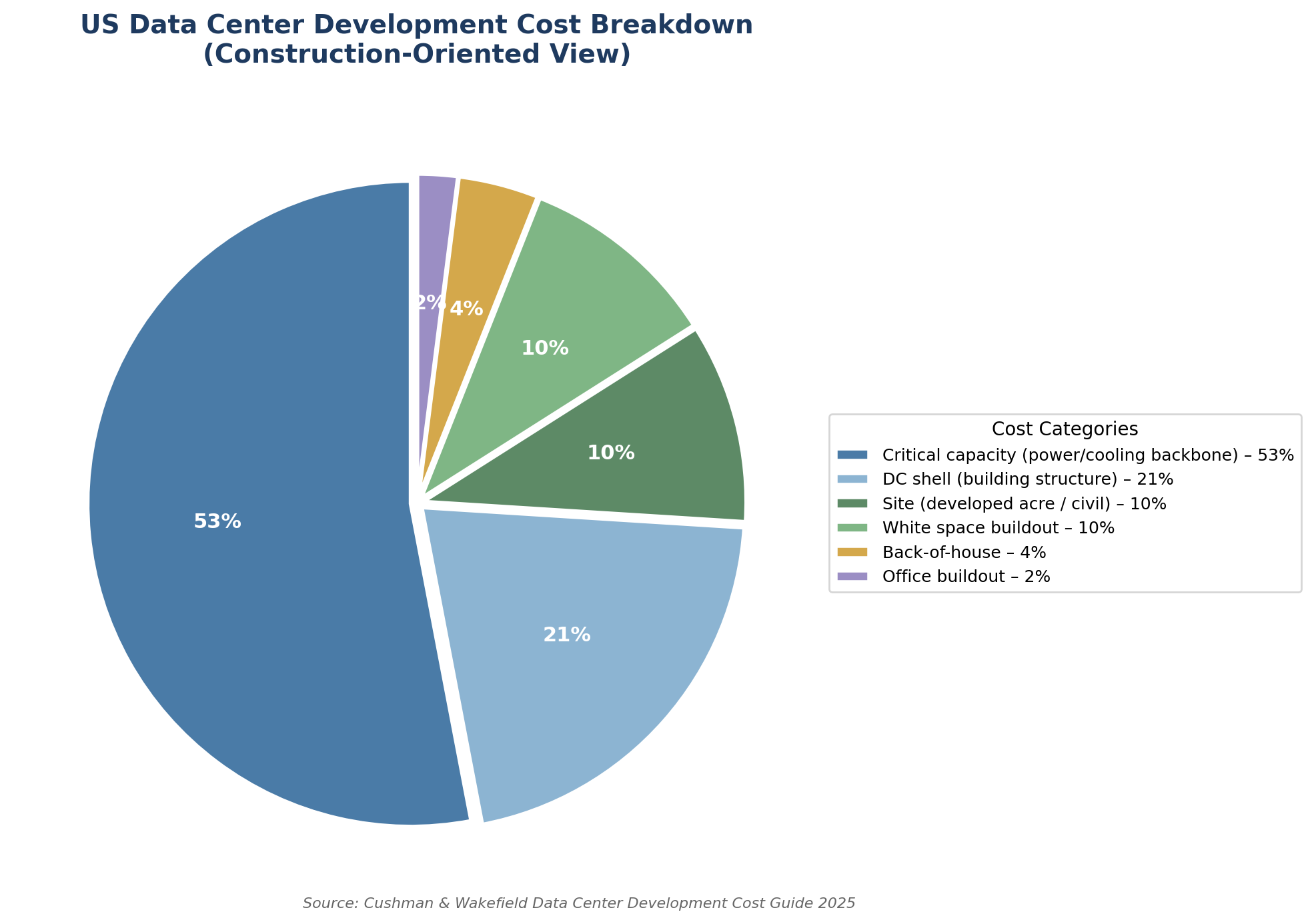
More than half the construction budget goes to critical capacity – power and cooling infrastructure. The building shell accounts for roughly a fifth. This is the leverage point for modular: if you can reduce or eliminate building shell requirements while maintaining power and cooling capacity, you've found savings without sacrificing capability.
CAPEX: The Seven Line Items That Actually Move Price
Forget percentage breakdowns for a moment. Here's where the money goes – and what makes each line item swing.
1. Site Preparation and Civil Works
Grading, foundations, drainage, fencing, crane access, laydown area. This behaves like a fixed-cost floor at small scale and shrinks proportionally as you grow. But it can spike sharply if your site needs utility trenching, environmental remediation, or heavy foundations for large gear.
In the Schneider prefab-vs-traditional comparison, "space cost" (land, building, site prep) was identified as the largest savings opportunity for modular – because outdoor modular yards can avoid part of the building shell requirement entirely. That's the leverage point if you have the land but not the appetite for a 24-month construction project.
2. Power Infrastructure (The Schedule Killer)
Switchgear, transformers, UPS, battery systems, generators, ATS/STS. This is the most common source of both cost inflation and schedule risk. The 2025 Cushman & Wakefield guide reports switchgear lead times averaging 46–48 weeks, with generators and chillers often exceeding 30 weeks and sometimes stretching to 110 weeks.
Read that again. Nearly a year for switchgear. Over two years for some generators. If your RFS date is inside those windows and you're starting from scratch on electrical design, you're not buying a modular data center – you're buying a prayer.
3. Cooling Infrastructure
Cost here is driven by design approach (DX vs chilled water vs hybrid), economizer viability in your climate, containment strategy, and whether you need liquid cooling readiness. High-density programs – anything pushing 40+ kW per rack – shift cost away from air distribution footprint toward liquid cooling loops, CDUs, and upgraded heat rejection.
The climate question matters more than most buyers realize. If you're deploying in Northern Europe with significant hours below 15°C, free cooling can materially change both CAPEX (simpler mechanical plant) and OPEX (lower energy draw). If you're in the Gulf, you're paying for mechanical cooling no matter what – plan accordingly.
4. Module Costs (The Bundle You're Actually Buying)
When vendors quote "module cost," they're bundling structural housing, factory integration and testing, embedded safety systems (fire suppression, monitoring), and sometimes monitoring software. Factory integration increases materials cost compared to traditional on-site assembly – but it can reduce field labor and commissioning risk substantially.
Form factor matters here. According to Schneider's modular taxonomy framework, a skid-mounted power module can cost up to 40% less than an equivalent enclosure design, because you're not paying for the housing. But skids require indoor placement or additional weatherization – so the savings only materialize if you have the space.
5. Electrical Distribution (Inside the White Space)
Busway, PDUs/rPDUs, RPPs, cabling. Sensitive to rack count and density. Higher density means more capacity per distribution run, which can improve efficiency – but it also means beefier infrastructure rated for the load. The Schneider 440 kW comparison identifies power density as a key variable that alters CAPEX outcomes: lower density requires more modules (or larger buildings), increasing material overhead.
6. Shipping and Logistics
This line item can dominate variance for containerized and enclosure-based builds. Standard ISO container dimensions have logistics advantages – they fit on trucks and ships designed for them. Non-ISO form factors and oversized widths frequently require special shipping permits, police escorts, and complex on-site lifting plans. Budget accordingly.
7. Permitting and Inspections
Not just administrative overhead. Permitting impacts design decisions: whether a module is treated as equipment versus building, fire and life-safety scope, and whether local authorities require full building-code compliance for personnel-occupiable enclosures. If your module includes walk-in IT space, expect egress requirements to apply.
Scope Boundary Matrix: What's Inside the Module vs Site Works
When comparing quotes, scope mismatch is where vendors hide cost. Use this matrix to normalize what you're actually comparing:
Pro tip: If a quote doesn't explicitly state where switchgear, generators, and site works sit, it's not a quote – it's a teaser.
OPEX: The Variables That Dominate Five-to-Ten-Year TCO
A US Chamber of Commerce economic report estimates annual operating expenditure at roughly 8.6% of initial CAPEX, broken down as: power (~40%), staffing (~15%), taxes and insurance (~5.5%), and maintenance/administration/other (~39.5%). Power dominates – but the "other" bucket is where modular can create operational leverage.
The PUE Equation (Why It's Not Just Efficiency Theater)
PUE – Power Usage Effectiveness – is standardized under ISO/IEC 30134-2. It measures total facility energy divided by IT equipment energy. Industry surveys continue to show a global average around 1.56, though leading new builds in temperate climates can achieve 1.2–1.3.
Here's why it matters in euros and dollars: assume a constant 1 MW IT load running continuously. Annual facility energy equals IT load × PUE × 8,760 hours. Moving from PUE 1.6 to PUE 1.3 saves roughly 2,628 MWh per year. At the EU non-household average of approximately €0.19/kWh (Eurostat H1 2025), that's roughly €500,000 per year in energy savings. Over a ten-year horizon, that 0.3 PUE delta represents a €5M difference.
Regional benchmarks matter here. IEA estimates put the global average PUE at around 1.41 in 2024, with the US lower (~1.32) and Europe higher (~1.45). If you're deploying in a high-electricity-cost region, every tenth of a point on PUE should be a design discussion, not an afterthought.
Where Modular Changes OPEX
Modular impacts operating costs through three mechanisms. First, equipment standardization simplifies your spares strategy and makes maintenance procedures repeatable across modules. Second, factory-integrated monitoring and serviceability design can reduce truck rolls and accelerate triage – assuming the remote monitoring actually connects to your operations center. Third, and often undervalued: rightsizing. When you can add capacity in 100–500 kW increments instead of MW-scale buildouts, you avoid the chronic part-load inefficiency of oversized facilities waiting for demand to catch up.
Timeline: The Constraints That Actually Gate Your Schedule
Vendors love to quote "3–6 months" (and we do so too) or even "weeks, not years." Those numbers can be real – for the factory build phase. But the factory build is rarely the critical path.
Constraint #1: Grid Interconnection
The International Energy Agency reports that within the European Union, grid-connection wait times can range from 2 to 10 years, with core "FLAP-D" hubs (Frankfurt, London, Amsterdam, Paris, Dublin) averaging 7–10 years. That's not a typo. If you're planning a multi-MW deployment in a constrained European market and you don't already have a power allocation, you're looking at a power procurement problem, not a modular manufacturing problem.
This is the single most important lead-quality filter for any serious buyer. If you're asking for capacity in a constrained market inside a 6–12 month window without a grid allocation, you need to solve for power before you solve for modules.
Constraint #2: Long-Lead MEP Equipment
Even with a site and power allocation, equipment lead times dominate. The Cushman & Wakefield guide documents switchgear at 46–48 weeks, generators frequently exceeding 30 weeks and sometimes 110 weeks, and chillers in similar territory. These aren't module lead times – they're component lead times. If your module vendor doesn't have switchgear in inventory or on order, their "12-week delivery" estimate doesn't include the year you'll wait for electrical gear.
Where Modular Actually Helps: Parallelism
The real timeline advantage of modular isn't speed in absolute terms – it's parallel workstreams. While your site pad is being poured and permitting is in process, modules can be manufactured and tested in a controlled factory environment. Vertiv claims >40% time savings versus conventional builds under suitable conditions. That's not fantasy – but it requires parallel execution, not just a modular purchase.
The following timeline illustrates the gating logic – note how the power delivery and MEP procurement tracks often extend well beyond module manufacturing:
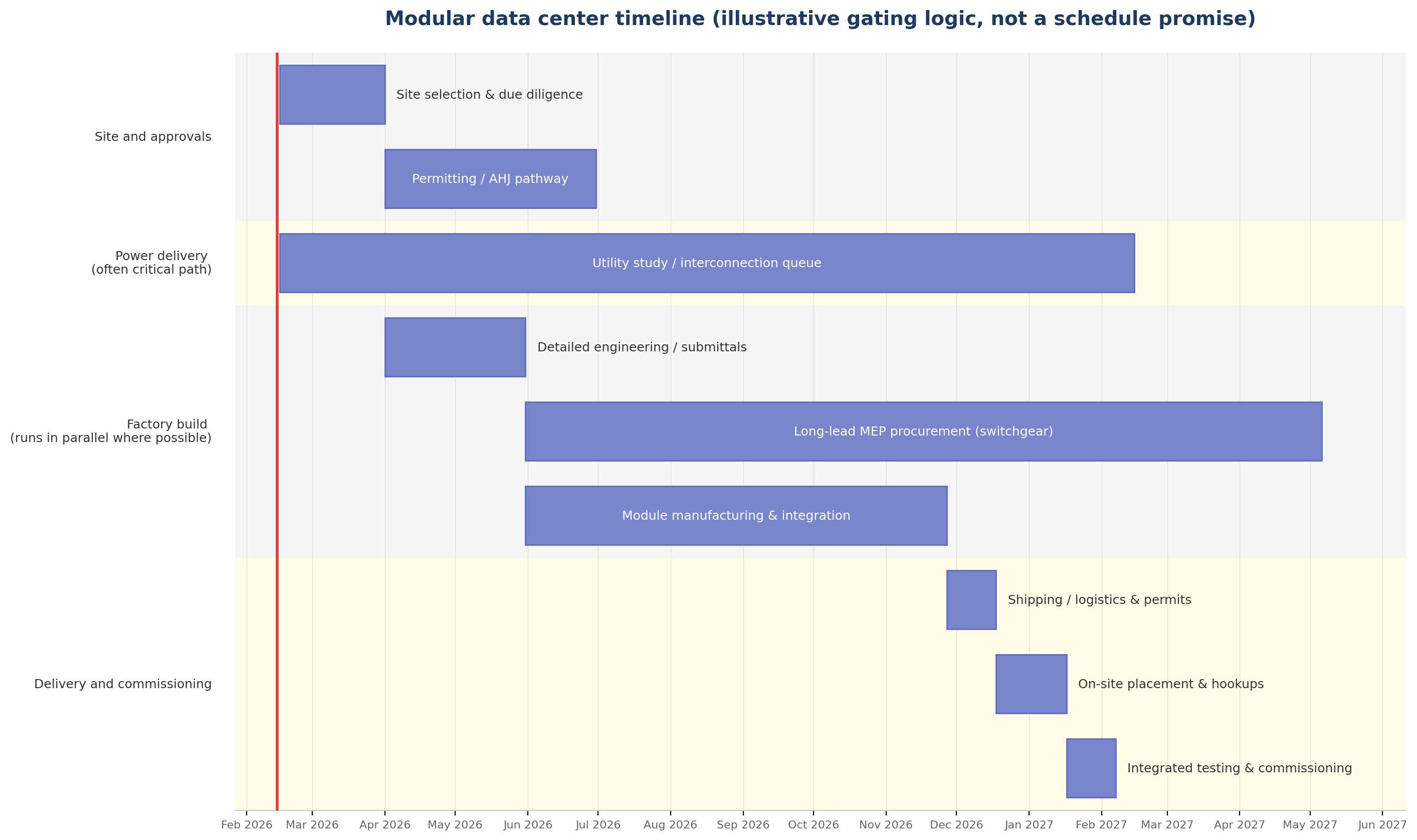
Key insight: The power delivery track (utility study and interconnection queue) runs the full year and often determines your actual RFS date. Module manufacturing completes in 6 months, but you can't energize without grid connection. Plan accordingly.
How to Compare Modular Data Center Quotes: The Checklist
Before you compare prices, confirm you're comparing the same scope. Run every quote through these questions:
Power architecture: Is switchgear included or excluded? What about transformers, generators, ATS/STS? What's the service voltage assumption?
Cooling scope: DX, chilled water, or hybrid? Is the condenser/chiller in-module or external? What's the design ambient temperature?
Redundancy level: N, N+1, or 2N? What's covered (UPS, cooling, power distribution)? What runtime is assumed?
Site works: Is foundation included? Fencing? Utility tie-in labor? Crane/rigging?
Logistics: Is shipping included or excluded? For non-ISO enclosures, are permit costs estimated?
Testing and commissioning: Is FAT included? SAT? Integrated systems testing?
Warranty and service: What's the warranty period? Is extended warranty priced? Is remote monitoring included or extra?
Lead time definition: Is the quoted lead time from order to FAT, or from order to RFS? Are long-lead components already on order?
The Five Inputs You Need Before Any Quote Makes Sense
Any vendor who quotes without these inputs is either padding heavily or planning to re-quote later:
1. IT Load and Phasing: What's the Day 1 requirement in kW/MW, and what's the 24-month expansion plan? This sizes everything.
2. Density and Cooling Roadmap: What's the average kW per rack, and what's the expected peak? Is liquid cooling in scope now or later? This determines cooling architecture.
3. Redundancy and Availability: N, N+1, or 2N? What runtime on UPS? Generator scope? This sets the power infrastructure tier.
4. Site Status and Power Path: Is there a secured site? What's the permitting status? Is there a utility interconnection allocation, or are you solving for behind-the-meter generation?
5. Target RFS and Driver: What's the required ready-for-service date, and what's driving it (contract deadline, capacity exhaustion, outage remediation)? This determines what's realistic.
If you can't answer these five questions, you're not ready for a quote – you're ready for a design consultation.
Regional Cost Factors: EU vs US vs APAC
United States: The benchmarks cited earlier ($9.3M–$15.0M per MW) are US-centric. Equipment lead times from the Cushman & Wakefield guide apply here. Electricity prices vary substantially by state and contract structure, but are generally lower than EU averages.
European Union: Higher electricity costs (averaging ~€0.19/kWh for non-household consumers) make PUE optimization more economically compelling. But the dominant factor is grid interconnection: 2–10 year wait times in many markets mean power allocation is the first constraint to solve. Financing costs over multi-year waits can materially change project economics.
APAC: Too diverse for regional averages to be useful. Japan and Singapore sit at the high end of development cost pressure. Australia has expensive power and slow grid processes. Southeast Asian markets vary widely. Vendor case studies from China show aggressive deployment timelines (months-level) using prefabricated approaches, but regulatory and supply chain contexts differ significantly.
The Bottom Line
Modular data center cost isn't a number you look up. It's an output of decisions about power, cooling, redundancy, site, and timeline – decisions that interact in ways that make simple $/kW comparisons misleading at best.
The vendors who help you scope correctly will also be the ones who deliver correctly. The ones who quote fast without asking questions are either building in margin for surprises or planning to surprise you later.
If you're researching modular data center pricing and you now realize you don't have the five inputs needed for a meaningful quote, that's progress. The next step is a design conversation, not a price comparison.
Ready to scope your modular data center project?
We run structured design reviews that map your requirements to a bounded configuration – so you get quotes that actually mean something. Request a design consultation →
