July 20, 2026
On-Premise AI Inference: Costs, Privacy, and the Case for Running Models Locally
On-premise AI inference cuts costs up to 16x vs cloud APIs at high utilization and keeps data in-house under GDPR and the EU AI Act.
On-premise AI inference means running language models on infrastructure you own and control, instead of renting a cloud API by the token. For sustained, high-volume workloads it can be dramatically cheaper, amortized self-hosted inference has fallen to roughly $0.02–$0.11 per million tokens on modern GPUs (SemiAnalysis InferenceMAX, 2025), versus $3–$30 per million tokens for mid-tier and frontier cloud APIs (Introl, 2026). Against a typical mid-tier API at good utilization, that gap is about 16×. It also keeps every prompt, log, and document inside your own building, which, under the EU AI Act and GDPR, is increasingly the only defensible answer.
This post covers the real cost math, the utilization threshold where on-prem wins, the regulations pushing inference in-house, what open-weight models can actually do now, and why factory-built modular infrastructure is the missing piece.
Is on-premise inference actually cheaper than the cloud?
Yes, but only when you run the numbers carefully and stop comparing against the wrong thing.
The headline is real. a16z's "LLMflation" analysis found that inference cost for a model of equivalent performance falls roughly 10× per year; GPT-3-class capability dropped from about $60 per million tokens in late 2021 to $0.06 by 2024 (a16z, 2024). On modern hardware, SemiAnalysis's InferenceMAX benchmark reports NVIDIA B200 serving open models at around $0.02 per million tokens after software optimization, with the Blackwell generation cutting cost per token roughly 15× versus the prior generation (SemiAnalysis, 2025).
Now put that next to what you pay a cloud provider. A mid-tier API blends to roughly $1.60 per million tokens at a typical input-to-output mix; premium frontier models run higher (Introl, 2026). Divide, and the "16×" number the industry keeps quoting holds up as a mid-tier comparison. Against premium APIs the multiple is larger. Against the cheapest budget APIs (DeepSeek, Gemini Flash-Lite, self-served small models at $0.06–$0.30 per million tokens), it narrows to near parity.
So the honest framing is up to ~16×, and more against premium APIs, less against budget ones. Not a flat constant. The number that decides which side of that range you land on isn't the model. It's utilization.
What utilization do you need before self-hosting pays off?
Here's the mistake most buyers make: they price a GPU as if it runs flat-out 24/7. It doesn't.
A GPU idling at 10% load inflates its per-token cost by roughly 10× (Introl, 2026). Below about 70% sustained utilization, cloud typically wins on total cost of ownership; above 80%, on-prem starts to win over a three-year horizon (Spheron, 2026). The break-even against hyperscaler on-demand pricing lands somewhere between 50% and 83% utilization depending on model and region.
Model size moves the bar. A 7-billion-parameter model needs around 50% sustained utilization to beat GPT-3.5-class pricing, while a 13B model reaches parity at only ~10% utilization, because the bigger model displaces a more expensive API alternative (Introl, 2026). A 2025 academic cost-benefit study across 54 deployment scenarios found small open models (under 30B) break even in 0.3–3 months, and medium enterprises processing 10–50 million tokens a month hit break-even in 3.8–34 months on dual-A100 hardware (arXiv 2509.18101, 2025).
The catch worth stating out loud: most production inference teams run at only 40–65% utilization because traffic is bursty (Spheron, 2026). The 80–90% that makes on-prem look unbeatable is rarely hit outside batch pipelines. Which is why the smart architecture is usually hybrid: keep baseline and sensitive traffic on-prem, burst the overflow to an API.
Why do regulators keep pushing inference on-premise?
Cost is the headline. Sovereignty is the deeper reason, and for regulated industries it's the one that actually forces the decision.
The EU AI Act (Regulation (EU) 2024/1689) entered into force on 1 August 2024, with high-risk obligations landing 2 August 2026 and penalties reaching up to 7% of global annual turnover, higher than GDPR's 4% (European Commission, 2024). GDPR has applied since 2018. DORA has bound EU financial entities since January 2025, requiring full audit rights over the AI and ICT supply chain. NIS2 is transposing across member states. The European Health Data Space is close behind for clinical data.
Stack those together and the picture is clear. When your prompts contain patient records, transaction data, or defense-relevant material, routing them through infrastructure you don't control creates transfer risk and audit gaps that these frameworks are specifically written to catch. Running inference on your own hardware keeps logs, audit trails, and chain of custody in-house, and removes cross-border transfer risk at the root. For a deeper treatment of the compliance case, see our analysis of sovereign data infrastructure for regulated industries and why owning your compute beats renting intelligence.
The regulation won't get looser. The workloads won't get less sensitive. Plan accordingly.
Can open-weight models actually do the work?
A few years ago the answer was "for demos, maybe." Now the gap is small enough that most enterprises won't notice it.
The 2025 cost-benefit study found medium open models (gpt-oss-120B, GLM-4.5-Air, Llama-3.3-70B) running on about $30,000 of hardware with under 10% accuracy loss versus commercial APIs (arXiv 2509.18101, 2025). DeepSeek R1 delivers comparable reasoning at roughly 90% below Western incumbent pricing (Introl, 2026). a16z put it starkly: a 1-billion-parameter model today outperforms a 175-billion-parameter model from three years ago (a16z, 2024).
Quantization does a lot of the heavy lifting. Moving from 16-bit to 4-bit precision gives at least a 4× improvement in memory and throughput; 4-bit cuts model size by about 75% at modest accuracy cost (a16z, 2024). A Gemma 3 4B model fits in roughly 4.2 GB of RAM. For most business tasks (document processing, retrieval, support automation, code assistance), an open model in the 30B–70B class is enough. The chip choices matter here too; we broke down the trade-offs in GPU vs LPU vs NPU for inference infrastructure.
What can you actually automate with a local model?
Plenty, and this is where the cost argument stops being abstract.
Local LLMs handle document processing and OCR, retrieval-augmented generation over private archives, customer-support automation, and increasingly agentic workflows, autonomous agents that read a document, infer missing fields from context, and validate against an ERP system (LlamaIndex, 2025). Organizations using AI-driven OCR report processing times cut 50–70% versus manual methods (LlamaIndex, 2025). The intelligent document processing market alone was about $10.6 billion in 2025 and is projected past $90 billion by 2034 (LlamaIndex, 2025).
The point of keeping it local isn't ideology. It's that your proprietary corpus (contracts, claims, engineering drawings, patient files) never leaves the building. The RAG index sits next to the data it indexes.
Why does local inference need modular infrastructure?
Because "on-prem" in 2026 does not mean a couple of GPUs in a wiring closet. It means high-density, liquid-ready racks, and most existing buildings can't host them.
Traditional enterprise racks run 10–15 kW. AI inference racks need 40 kW and up (Hanwha Data Centers, 2025). Above roughly 30–40 kW per rack, air cooling physically can't move enough heat, so liquid cooling becomes mandatory (CoreSite, 2025). Liquid-cooled facilities also run more efficiently. PUE of 1.10–1.20 versus 1.40–1.60 for air-cooled enterprise colocation (Introl, 2025). Position matters too: for inference, we only recommend the on-prem density argument at 40 kW per rack and above, where dedicated infrastructure is actually necessary rather than nice to have.
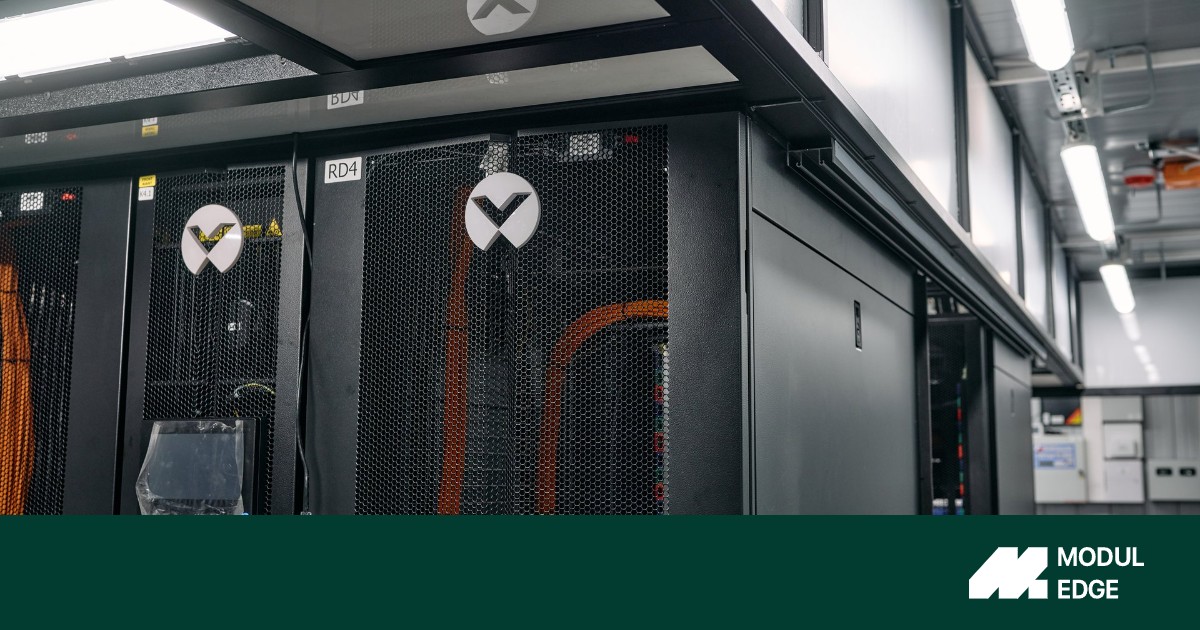
This is the gap between cloud-API convenience and raw hardware. A factory-built modular data center closes it. ModulEdge units support 5–150 kW per rack with liquid cooling integrated at build, deliver in 3–6 months rather than 18–36, and drop compliant capacity exactly where your data lives. The infrastructure layer is where our edge AI inference module design goes deep, and if you're wondering whether you even need the latest silicon, Blackwell is probably overkill for most inference needs.
Run the numbers on your own workload. If your inference is sustained, your data is sensitive, and your utilization clears 60–70%, the case for on-prem isn't philosophical. It's arithmetic. The only remaining question is where you put the racks, and that's the part we build. For the full picture of what modular delivers, start with our definitive guide to modular data centers.
Frequently asked questions
Is running AI models on-premise really cheaper than cloud APIs? It can be, for sustained high-volume workloads. Amortized self-hosted inference has fallen to roughly $0.02–$0.11 per million tokens on modern GPUs (SemiAnalysis InferenceMAX, 2025), versus $3–$30 per million tokens for mid-tier and frontier cloud APIs (Introl, 2026). The catch is utilization: below about 70% sustained GPU utilization, cloud usually wins on total cost, and against the cheapest budget APIs the advantage narrows to near parity (Spheron, 2026).
How much GPU utilization do I need before self-hosting pays off? For smaller models the bar is higher, a 7B model needs around 50% sustained utilization to beat GPT-3.5-class pricing, while a 13B model reaches parity at only about 10% because it displaces a pricier API (Introl, 2026). Against hyperscaler on-demand pricing, break-even generally sits between 50% and 83% utilization. Because most teams run at 40–65% in practice, batch workloads and hybrid overflow designs matter.
What regulations push companies to keep AI inference on-premise? GDPR (in force since 2018), the EU AI Act (in force since 1 August 2024, penalties up to 7% of global turnover), DORA for financial entities (applicable January 2025), NIS2, and the forthcoming European Health Data Space all impose data-governance and audit obligations (European Commission, 2024). Running inference on your own infrastructure keeps logs and data chain-of-custody in-house and removes cross-border transfer risk.
Can open-weight models match commercial APIs? They are close. A 2025 study found medium open models running on about $30,000 of hardware with under 10% accuracy loss versus commercial APIs (arXiv 2509.18101, 2025), and DeepSeek R1 delivers comparable reasoning at roughly 90% lower cost (Introl, 2026). For most business tasks, open models in the 30B–70B class are sufficient.
What can local LLMs automate in a typical enterprise? Document processing, OCR, retrieval-augmented generation over private archives, customer-support automation, code assistance, and increasingly autonomous agentic workflows that read, infer, and validate data against systems like ERPs (LlamaIndex, 2025). Organizations using AI-driven OCR report processing times cut 50–70% versus manual work.
Why does on-premise inference need special infrastructure? AI inference racks draw 40 kW and up versus 10–15 kW for traditional IT, and above roughly 30–40 kW air cooling can't keep up, so liquid cooling becomes necessary (Hanwha, 2025; CoreSite, 2025). Factory-built modular data centers deliver this liquid-ready, high-density capacity in 3–6 months instead of 18–36, letting enterprises stand up sovereign on-prem inference quickly and close to their data.
