October 10, 2026
Single-Phase vs Two-Phase Immersion Cooling: A Buyer’s Comparison
Compare the two immersion cycles using supported equipment, thermal interfaces, maintenance trials, fluid supply and matched cost assumptions.
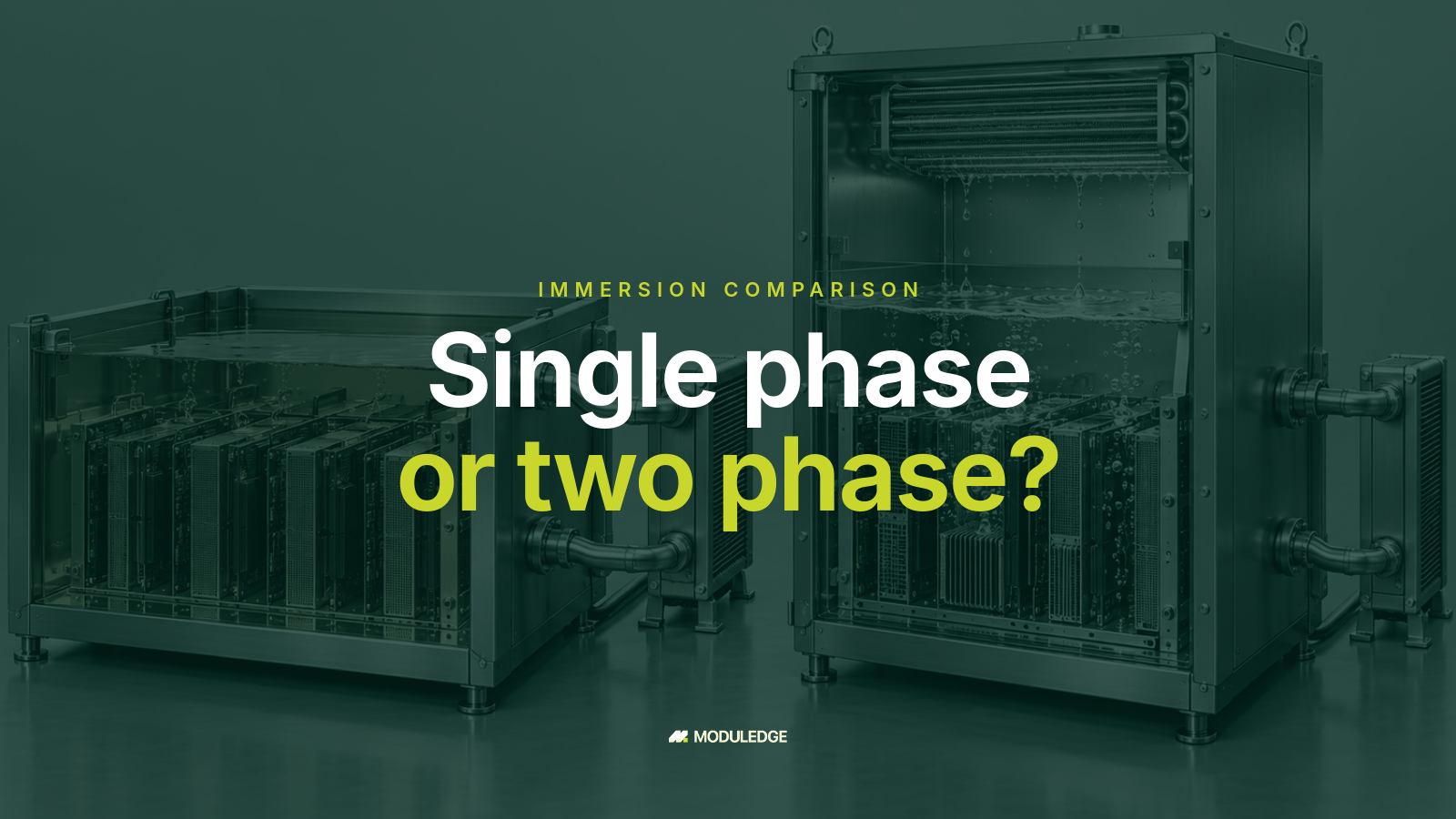
Single-phase immersion cooling keeps the dielectric working fluid liquid; two-phase immersion cooling removes heat through evaporation and condensation. Neither label selects the better system for your data center. Choose from supported hardware, tested thermal conditions, fluid availability and a service procedure your operator can execute.
This comparison is for teams evaluating immersion proposals. If the first decision is whether to use immersion at all, read our immersion-cooling guide for data centers and AI. For other architectures, use the broader liquid-cooling guide.
TL;DR
- One phase means sensible heating of a liquid; two phases add vaporization and condensation.
- Phase count does not specify the fluid chemistry, tank format, server support or whole-system energy use.
- Ask both suppliers to prove component temperatures and useful workload at the same facility conditions.
- Compare the full service footprint, installed load, fluid lifecycle and maintenance trial.
- In 2026, check the exact fluid's supply route: 3M has completed its PFAS manufacturing exit.
How the two heat-transfer cycles differ
In a single-phase system, liquid receives heat from components and gives it up through a heat exchanger while remaining liquid. Movement can involve natural or forced convection. In a two-phase system, working fluid evaporates, then condenses on a cooled surface and returns as liquid. These definitions come from the OCP Immersion Requirements, revision 2.1.
The phase-change mechanism explains how heat leaves the electronics. It does not specify how the condenser or heat exchanger is cooled outdoors. Draw the proposed path all the way to the ambient environment, and name the responsible supplier at each interface.
Ask for a diagram of the actual proposal. “Two-phase” can describe the working-fluid cycle without telling you the enclosure arrangement, service access or facility circuit. “Single-phase” likewise does not tell you whether liquid movement is pumped or driven by convection.
A comparison table for the supplier meeting
Use these questions to compare actual systems. The table is a buyer framework, not a universal performance ranking.
| Question | Single-phase proposal | Two-phase proposal |
|---|---|---|
| What carries heat? | Liquid heating and cooling | Evaporation followed by condensation |
| What must be demonstrated? | Component temperatures, fluid movement and heat-exchanger duty | Component temperatures, boiling conditions and condenser duty |
| Which fluid-side conditions matter? | Operating liquid-temperature range, required circulation and pressure losses | Boiling conditions, operating pressure and vapor/condenser limits |
| What reaches the facility? | Heat-exchanger duty, facility inlet/outlet temperatures and flow | Condenser duty, required cooling temperatures and flow |
| What happens during service? | Demonstrate isolation, extraction, fluid handling and return | Demonstrate the same sequence, including vapor management |
| How is the fluid supported? | Named product, test plan and replacement supply | Named product, test plan and replacement supply |
| Which option costs less? | Compare current supported quotations over the same workload, site scope and operating period | |
A proposal should give you enough information to run the same evaluation twice. When suppliers use different inlet conditions, excluded auxiliaries or footprint measures such as tank area versus installed service area, ask for a common case before comparing the headline values.
Fluid properties are inputs, not a ranking
The OCP Base Specification for Immersion Fluids discusses properties in combination and at relevant temperatures. A high specific heat alone cannot rank a cooling solution: circulation, viscosity, heat transfer and the equipment arrangement also enter the design.
For each quotation, ask for the exact product and grade, current technical and safety data, operating range, quality limits, sampling method and replacement policy. Request the evidence connecting that fluid to the proposed server and tank. A generic phrase such as “synthetic fluid” leaves too much unspecified for procurement.
Do not equate fluid chemistry with phase count. Record both explicitly. The compatibility review must follow the actual pairing; it cannot be copied from another fluid merely because the two systems have the same number of phases.
A heat-balance example shows why flow figures differ
Consider an illustrative single-phase liquid path carrying 100 kW with a 10 K temperature rise. Assume specific heat of 2.0 kJ/(kg·K) and density of 800 kg/m³ at the operating condition. These are chosen example inputs, not properties of a named commercial fluid.
Mass flow = 100 ÷ (2.0 × 10) = 5.0 kg/s. Volume flow = 5.0 ÷ 800 × 3,600 = 22.5 m³/h.
At the same heat load and properties, a 5 K rise doubles the required flow to 45 m³/h. That sensitivity tells the buyer why a flow quotation needs its temperature rise and fluid assumptions beside it.
In a simplified phase-change example, assume a latent heat of 100 kJ/kg and 100 kW transferred entirely through vaporization. The corresponding evaporation rate is 100 ÷ 100 = 1.0 kg/s. This is a vaporization mass rate, not a pump duty or a facility-water flow. A real balance may include sensible heat and other heat paths.
These relationships do not prove that one system consumes less electricity. Pump and fan power, pressures, condenser or exchanger performance and outdoor conditions still need a complete design. Do not compare a dielectric circulation figure with a condenser water flow as if they were the same circuit.
Test the equipment you intend to buy
The OCP material-compatibility publication shows why fluid/material results need their specific pairing. Use that as a reason to request production-configuration evidence, not as a blanket approval list for every material with the same name.
Trial the same production equipment, networking and workload at matched facility conditions. Record temperatures, useful output and errors together. For single-phase, include the specified circulation conditions; for two-phase, include the boiling pressure and condenser conditions. Identify any untested configuration or supplier approval before procurement.
Maintenance and fluid loss belong in the comparison
Ask each supplier to perform the same representative intervention and report the complete result: people required, tools, elapsed time, fluid consumed or recovered, restart checks and return-to-supplier handling. Agree the procedure before the trial so that a quick demonstration does not omit cleanup or the recovery of a failed component.
For two-phase proposals, request evidence of vapor management during normal operation and the planned service opening. For either option, ask for measured fluid-loss data with operating and maintenance conditions. Treat an unqualified “zero loss” statement as a question to resolve in the quotation.
Draw the actual work area into the layout. Reserve the removal path, tools, handling space and access to the facility interfaces. A tank's base area is only one part of the occupied space. Likewise, a filled tank's weight is only one input to the structural review: support reactions and the installation route matter too.
What 3M's exit means for a 2026 fluid decision
3M states that it completed its exit from PFAS manufacturing at the end of 2025. A new project should therefore verify current supply and long-term support rather than rely on an old fluid catalog or a previous manufacturing assumption.
This supplier event does not establish that every two-phase fluid is unavailable, that every immersion fluid has the same chemistry, or that the technology is prohibited. Those are separate questions. For the actual fluid, request the current manufacturer, stock source, technical data, replenishment route and an approved transition plan if supply changes.
For a European project, also obtain a fluid-specific compliance assessment for the installation and intended lifecycle. Check the exact substance and applicable requirements at procurement. Do not convert a broad PFAS headline into a legal conclusion about an unidentified fluid.
Compare total cost with the same assumptions
Build a cost sheet in which both suppliers answer the same rows: supported IT, tanks, heat exchangers or condensers, facility plant, initial fluid, site work, commissioning, training, annual energy, consumables, labor, spares and end-of-life handling.
Use a common evaluation period, useful workload and availability requirement. Label estimates and exclusions. If a proposed system needs a different server configuration, show the server-cost and workload effects separately from cooling costs. This avoids assigning a computing-platform advantage to the choice of phase.
A credible comparison also tests changes in electricity price, load factor, maintenance frequency and fluid replenishment assumptions. Ask which input would change the result enough to reverse the choice. A narrow modeled advantage should lead to stronger evidence for that input before contract award.
Decide from evidence in three steps
- Confirm support. Identify the exact server/fluid/system combination and written warranty responsibility. Unresolved compatibility keeps the option in development.
- Prove the interfaces. Match thermal conditions, power, structural requirements and facility plant. Run the representative performance and maintenance trials.
- Compare the operating case. Use matched cost boundaries and credible supply assumptions, then document what would trigger a design review.
The evidence may favor a specific single-phase system, a specific two-phase system or another cooling architecture when the evidence is compared.
Connect the choice to the facility brief
ModulEdge's documented rear-door and direct-to-chip architectures are separate from an immersion design. An immersion proposal needs its own supported equipment and interface schedule before modular infrastructure fit can be assessed. The phase choice alone cannot determine the building, electrical or outdoor-cooling scope.
Bring the Cooling Interfaces Into the Facility Brief
Share the supported hardware, fluid/system proposal and site design conditions. Discuss which interfaces and acceptance evidence must be resolved before selecting modular infrastructure.
- Supported equipment and fluid
- Thermal and electrical conditions
- Layout and service requirements
- Supplier scope and evidence
Frequently asked questions
What does single-phase immersion mean?
The working fluid remains liquid as it receives and releases heat. Its circulation arrangement depends on the selected system.
What does two-phase immersion mean?
The working fluid evaporates to carry heat and condenses back into liquid. The condenser still needs a heat-rejection path.
Is two-phase immersion always more efficient?
No universal whole-system ranking follows from phase change. Compare useful workload and all included cooling energy at matched conditions.
Does two-phase immersion mean two liquid loops?
No. “Two-phase” refers to liquid and vapor in the working-fluid cycle. Loop count is a separate design detail.
Has 3M's exit made two-phase immersion impossible?
The exit is a reason to verify the exact fluid's current supply and support. It does not establish a conclusion about every supplier or system.
What should I ask both suppliers to demonstrate?
Ask for the same production equipment and workload trial, supported operating range, representative maintenance intervention and written responsibility for every interface.
