AI Factory vs AI Data Center: Infrastructure, Ownership and Deployment
Understand the boundaries between facility infrastructure, computing systems and AI services before comparing ownership, deployment and acceptance.
 By Yuri MilyutinManaging Partner, ModulEdge
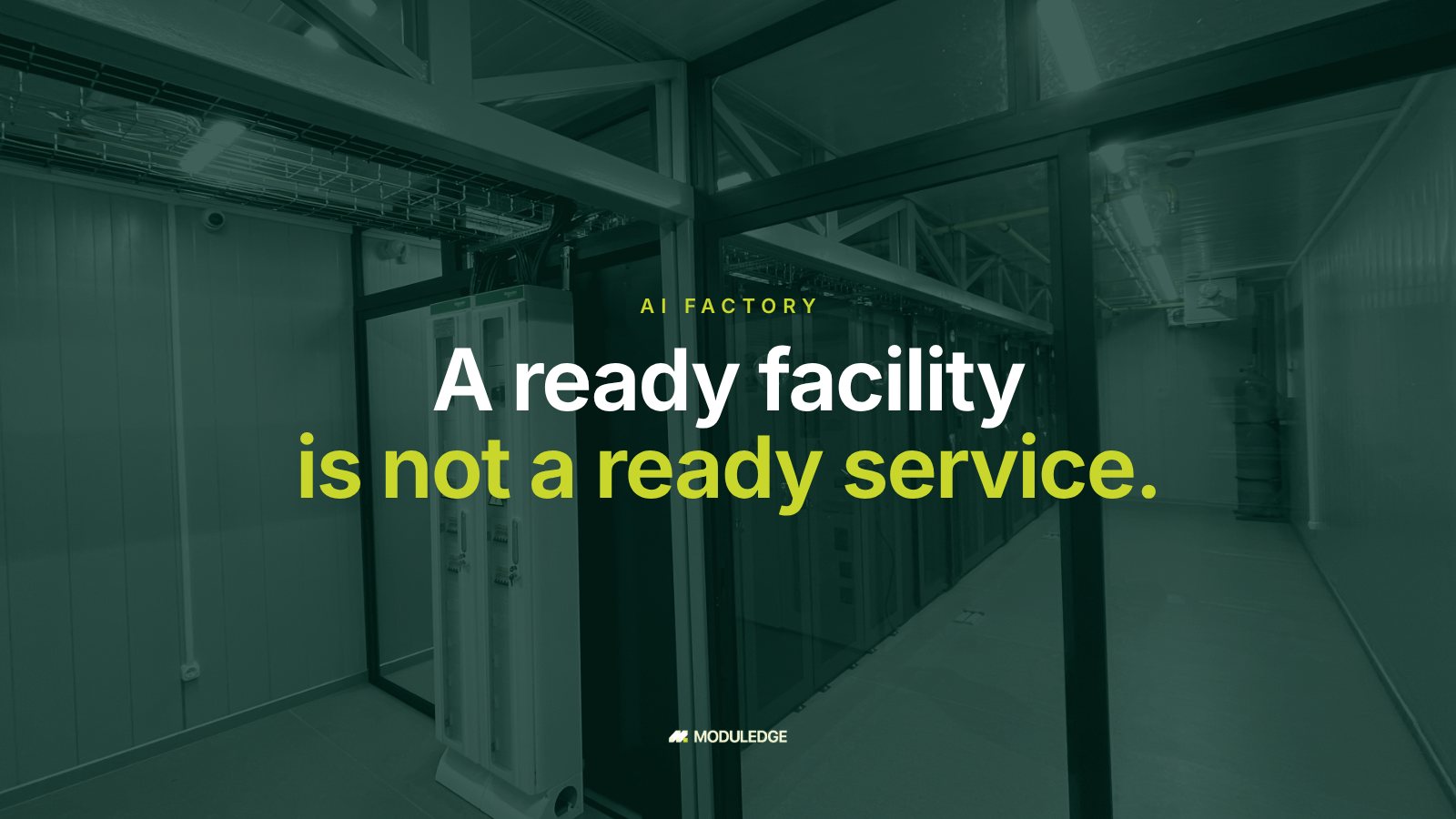
An AI data center provides the physical environment in which AI systems operate. An AI factory combines computing infrastructure with the data, software and operating processes used to develop or deliver AI services. The terms overlap: an AI factory can run inside an AI data center, and that facility can be delivered using prefabricated modular data centers.
The practical distinction is the scope being purchased and accepted. A facility can have available electrical capacity, functioning cooling and completed commissioning while the AI service still lacks usable data, supported software or an operating team. Conversely, a model that works in a cloud demonstration does not establish that the proposed on-site system can support its required demand.
Our AI data center build guide covers the physical design sequence. This comparison concentrates on the boundaries between that facility, the computing system and the service the buyer actually needs.
TL;DR
- Treat an AI factory as an operating environment connecting people, data, compute and software with a physical facility.
- Specify application quality and service requirements before translating the workload into servers, racks and facility interfaces.
- Separate facility capacity, IT-system capability and useful application output. Megawatts alone do not measure an AI service.
- A facility owner can host equipment owned and operated by a compute tenant. Equipment procurement and operating responsibility need explicit agreements.
- Factory integration can move assembly and testing upstream. Site readiness, software readiness and acceptance remain separate workstreams.
- Accept the facility, cluster and application against their own criteria, then test the agreed operating cases across those boundaries.
What the terms describe
NVIDIA defines an AI factory around the AI lifecycle, including data ingestion, training, fine-tuning and inference. That description reaches beyond the building. Cisco similarly distinguishes an AI-ready physical environment from the operating stack that develops and delivers AI applications. These are vendor explanations, useful for understanding the category rather than universal procurement definitions.
A workable project vocabulary separates four objects:
| Object | What it describes | Evidence a buyer should request |
|---|---|---|
| AI service | The result delivered to users or another system | Workload, quality, latency, throughput and recovery criteria |
| AI computing system | Servers, accelerators, storage, networks and their supported software | Exact configuration, compatibility, measured workload results and lifecycle support |
| AI data center | Electrical, thermal, spatial and supporting infrastructure for the selected IT | Load schedule, interfaces, operating states, drawings and acceptance results |
| AI factory | The combined environment and processes that turn data and compute into repeatable AI work | An accountable service owner and an operating plan connecting the other three |
The word factory does not require every organization to train a foundation model. A deployment might serve approved models, fine-tune them for a task, operate a retrieval service or support several such activities. Describe the intended workflow instead of assuming that the largest training system represents every AI project.
Prefabrication answers another question: where are the facility systems manufactured and integrated? Modularity concerns how the design is organized and expanded. Neither term establishes the model quality, operator, ownership structure or service-level agreement. Our modular data center guide explains those delivery distinctions in more detail.
Define useful output before buying capacity
For an interactive service, the brief should identify the task, permitted data, model configuration, input and output lengths, concurrency and response targets. For training, it should identify the model or workload, dataset, completion objective, checkpointing and recovery behavior. Batch inference may be governed by a completion window rather than the response time of each individual request.
These distinctions affect procurement. Two systems reporting the same tokens per second may use different models, output quality, precision, prompt lengths or batching policies. A high-throughput result obtained by allowing long queues may not satisfy an interactive application. The MLPerf Inference framework makes this comparison discipline explicit through defined workloads, quality targets, scenarios and performance rules. A published benchmark is evidence for its tested conditions, not a substitute for the buyer's application test.
Write acceptance criteria in the language of the service. For example: an agreed set of document questions must meet the buyer's quality threshold and response-time distribution at a specified offered load, while preserving source-document permissions. Then identify the hardware and operating configuration that achieved it. Avoid an unsupported promise that a particular GPU count will serve an arbitrary number of users.
Keep a measurement record that another team can reproduce. It should identify the release and configuration, test-data treatment, request mix, observation period, offered demand, accepted output and failures. Report latency distributions rather than only their average when the service commitment depends on slower responses. Distinguish demand offered to the system from work it actually completed: a queue can hide overload during a short demonstration. Similarly, a large installed-memory total does not establish the memory available to one model after runtime overhead and other workloads. These checks connect a component specification to an operational commitment without pretending that the two are identical.
A simple illustrative pipeline shows why. Suppose separately measured stages can sustain 14 requests per second in retrieval, 12 in generation and 10 in an output-processing stage for the same request mix. Without changing the design, end-to-end sustained throughput cannot exceed the slowest stage's 10 requests per second. Queuing, variable request sizes and retries may reduce the achievable result further. Adding generation hardware alone does not resolve that bottleneck. These are assumed rates for explanation, not a benchmark or a capacity promise.
Storage belongs in this same service model. Specify which data is read during preparation, training or retrieval, where model artifacts and checkpoints are written, and how the working set changes during a run. A capacity total in terabytes cannot answer those questions. For an acceptance exercise, include the intended data placement and concurrent activity rather than a demonstration with everything already cached. Record time spent waiting for data, transfer behavior and the recovery path for interrupted work alongside accelerator activity. This does not prescribe a universal storage tier: the selected workload determines whether local storage, a shared system or a combination is appropriate. It makes the handoff between data engineering, platform engineering and the hardware supplier visible.
The facility brief follows the selected system. It should not begin with a desired marketing label and work backwards toward an invented application load.
Draw the facility, IT and software boundaries together
An integrated project still contains distinct responsibilities. A proposal should state who designs, procures, installs, operates and maintains each system; those duties need not sit with the same organization.
| Boundary | Typical questions to resolve | Consequence of leaving it open |
|---|---|---|
| Electrical | Where is capacity committed and metered? Who supplies conversion, protection and upstream equipment? | Facility and rack suppliers can assume different available inputs |
| Thermal | What are the liquid and residual-air duties, conditions and operating states? | The room or outdoor plant may not match the selected system |
| IT and fabric | Who supplies servers, storage, network hardware, cabling and supported configurations? | A delivered rack may lack the system around it |
| Platform software | Who owns scheduling, images, drivers, identity, observability and updates? | Hardware is installed without a repeatable operating platform |
| Application and data | Who approves models, datasets, retrieval permissions and quality tests? | A technically functioning cluster produces an unusable service |
| Operations | Who diagnoses incidents crossing these layers and authorizes changes? | Suppliers can each meet a narrow obligation while the service remains unavailable |
These are planning questions, not a claim that every project uses the same scope split. A single supplier may coordinate several layers; several suppliers may collaborate under one accountable integrator. In both arrangements, the purchaser needs the actual interfaces and acceptance obligations.
Software is a real infrastructure workstream. For example, Kubernetes GPU scheduling documentation describes vendor drivers and device plugins required to expose GPUs as schedulable resources. Owning GPU servers does not establish that the scheduling, application packaging or operating controls have been configured and supported. The software choice also needs to account for security, update compatibility and the team's operating competence.
Translate the equipment schedule without confusing ratings
An AI factory proposal can contain GPU power, server power, rack power, facility input and annual energy in the same presentation. They describe different boundaries. The design review needs an equipment schedule showing which figures are maxima, configured limits, measured averages or assumptions.
Take a small, illustrative system using four NVIDIA DGX B200 servers. The DGX B200 user guide lists 14.3 kW maximum system power. Four such system ratings total 57.2 kW. Add a separately assumed 4 kW maximum for the example's network, storage and management equipment, and the listed IT total becomes 61.2 kW.
This arithmetic does not design a data center. It does not include cooling auxiliaries, electrical losses, site services, future additions or the required behavior during faults. Nor should redundant power-supply ratings simply be summed and described as normal server consumption. The engineer still needs supported circuit arrangements, rack population, airflow, environmental conditions and protection coordination.
Suppose that same buyer mentions a 100 kW site supply. Subtracting 61.2 kW and treating the remainder as guaranteed spare IT capacity would be premature. The available supply boundary, auxiliaries, environmental design case and contingency requirements have to be checked. A service may also need spare computing capacity or a recovery arrangement that changes how many servers can carry committed demand.
The GPU data center procurement guide develops the equipment-to-facility process. For electrical behavior over time, our AI load-profile guide is the relevant next reading. Neither nominal capacity nor a daily energy average is a complete peak-load or failure-state specification.
Follow the heat beyond the computing rack
A liquid-cooled system needs its supported coolant conditions and hydraulic interface; it can still leave an air-side load. Air-cooled servers require a designed route from their inlet through heat removal to the final sink. Cooling topology follows the chosen OEM system, rather than an assumed universal rack-density threshold.
Separate heat capture at the IT equipment from heat rejection outdoors. The US Department of Energy's cooling-system explanation illustrates how heat can pass through several air and water circuits before reaching the atmosphere. Its example is an evaporative arrangement, not a requirement that every AI facility use a cooling tower. A recirculating internal liquid loop alone says nothing conclusive about annual site-water consumption.
For procurement, record temperatures, flow, pressure limits, fluid quality, isolation and responsibility for leak detection or response. Include outdoor weather and the required maintenance cases. The CDU sizing guide covers the liquid interface; the data-center water-budget guide addresses annual and peak water questions. Keeping these as explicit handoffs is more useful than repeating a whole cooling handbook in an AI-factory proposal.
Decide who owns the facility and who operates compute
An enterprise may own the facility and the IT, with internal teams or contractors operating both. A compute operator may lease suitable space and operate its own equipment. A site owner may develop infrastructure for a tenant without acquiring or operating the tenant's GPU fleet. Each arrangement can support AI services; the AI-factory label does not choose among them.
For an owner-and-tenant arrangement, define the permitted equipment envelope early. Rack power, mass, geometry, supported coolant conditions, network space and service clearances affect whether the tenant can use the facility. A commitment to provide a number of megawatts without those interfaces can leave both parties holding incompatible assumptions.
Also agree how equipment changes are handled. A tenant's later rack generation may alter thermal conditions, electrical distribution, network geometry or maintenance access. An expansion allowance needs specific space, plant, connection and operating provisions. It is not a guarantee that every future platform will fit unchanged.
Financial questions follow this allocation of assets. The facility owner evaluates development, occupancy, counterparties and facility operations. The compute operator additionally evaluates hardware acquisition, software capability and workload demand. These risks can be shared in different ways, but they should be visible. Our AI data center business-model article examines the broader ownership decision; the facility comparison here does not establish a universal investment return or utilization threshold.
Factory integration changes the handoff, not every dependency
Prefabricated modular construction allows agreed facility assemblies to be integrated and tested before shipment. That can make repeatable interfaces easier to inspect and can overlap with receiving-site work. The design needs sufficient stability before release, and the installed result still needs its site connections and acceptance.
Keep four readiness tracks in the programme: manufactured infrastructure, receiving site, IT systems and operating service. A completed factory assembly does not prove that permits, foundations, utility energization or network access are ready. A completed site does not prove that the server configuration, licenses, application data and operating procedures are ready.
Use a milestone register containing an accountable party, evidence and prerequisites for each handoff. Identify where partial releases are possible and which change would invalidate an earlier test. A late change in rack layout or power allocation can affect several packages, even when each supplier considers its own product finished.
The NVIDIA DSX POD comparison describes a specific factory-integrated approach and its conditions. A buyer evaluating that platform should use the named partner design and actual contract. Neither its headline deployment interval nor another supplier's module assembly time should be presented as the whole project's operating schedule. Site selection and readiness remain separate engineering work.
Accept three results, then prove their interfaces
Facility commissioning, cluster validation and application acceptance answer different questions. They should form one coordinated programme without being treated as interchangeable certificates.
| Acceptance layer | What it should establish | What it cannot establish alone |
|---|---|---|
| Facility | Installed electrical, cooling, controls and safety functions meet the agreed design and operating cases | Model quality or the application's end-to-end response |
| IT system | Hardware, firmware, networking, storage and supported runtime function as the specified system | Correct data permissions, user workflow or facility behavior in every contingency |
| AI service | Agreed requests meet quality, authorization, performance and recovery requirements | Compliance with every facility or legal obligation |
| Integrated cases | The agreed service behavior during selected failures, maintenance and recovery | Every future operating condition or an unbounded availability guarantee |
Select cases across boundaries. During a planned loss of one compute node, for example, establish what demand remains supported, whether work is retried and how recovery is reported. During an approved cooling or power maintenance case, establish the permitted IT operating state and the application's response. Specify these tests for an appropriate test environment or controlled maintenance plan, rather than experimenting on an operating service.
Record the configuration, workload, observations, exceptions and corrective actions. A factory test report can be valuable evidence while remaining narrower than site acceptance. A successful sample prompt is similarly narrower than an application test at the intended service load. Handover needs reproducible records, runbooks and accountable operations, not just a demonstration and administrator credentials.
Prepare a brief that suppliers can answer
Before comparing an integrated AI-factory proposal with a facility-only offer, normalize their scope. Include the intended service, equipment configuration, usable power position, cooling interfaces, responsibility matrix, readiness evidence and acceptance criteria. Separate included equipment from options and customer-supplied items.
Ask each bidder what remains with the purchaser after delivery: upstream electrical equipment, outdoor plant, network connectivity, application integration, licenses, staff, spares and recovery infrastructure. A lower price or shorter interval is not directly comparable if it stops at an earlier handoff. Our manufacturer, provider and integrator guide explains the delivery responsibilities behind those labels.
ModulEdge's role is physical infrastructure around selected equipment and a suitable site. The product comparison provides starting architectures; configuration work resolves the project interfaces. An owner developing capacity for a compute tenant can discuss that arrangement without treating tenant introductions as guaranteed occupancy. The purchase scope must state who supplies the servers, GPUs, software and operating service.
Frequently asked questions
Can training and inference share an AI-factory cluster?
They can be considered together, but the operating plan must protect each service's commitments. State how capacity is reserved, queued or reassigned, and whether maintenance or a training run may interrupt serving. Test the combined workload before treating spare capacity in one activity as available to the other.
Can a project start with inference and add training later?
Yes, if the later phase is assessed as a separate system and facility requirement. Define the expansion trigger and retained interfaces now, while leaving unpurchased capacity explicit. A successful inference deployment does not demonstrate that the same network, storage, power allocation or operating team can support the proposed training workload.
Who handles an incident when the equipment is healthy but answers are wrong?
The service owner needs an escalation path covering data, retrieval, model behavior and application changes. Record who can suspend a release, restore an approved version and authorize return to service. A hardware maintenance contract alone does not assign responsibility for the correctness of business outputs.
Which data and software assets belong in handover?
Agree an inventory covering approved images, configurations, model identifiers, evaluation sets, permissions, operational records and rebuild instructions, subject to the applicable licenses and data rights. State who maintains each asset after handover. Receiving equipment credentials without the approved versions and recovery material is an incomplete operating transfer.
What should trigger another application-acceptance test?
Define change categories in advance. A different model, precision, request policy, retrieval pipeline or resource-sharing arrangement may change the result even when the rack is untouched. Conversely, an equipment replacement may need compatibility checks without repeating unrelated business evaluations. The test scope should follow the change and its affected commitments.
Is high GPU utilization always the project's objective?
Utilization is a diagnostic measure, not the service outcome. A team may deliberately retain spare capacity for demand spikes or recovery. Compare accepted output, response commitments, cost and resilience together; investigate idle time before interpreting it as either waste or justified headroom.