August 1, 2026
Data Center Cooling for Extreme Heat: Design Lessons from the Gulf and Beyond
Data center cooling for extreme heat: legacy Gulf PUE above 1.8 vs. Google's 1.09 and Meta's 1.08 fleet averages, and what closes the gap.
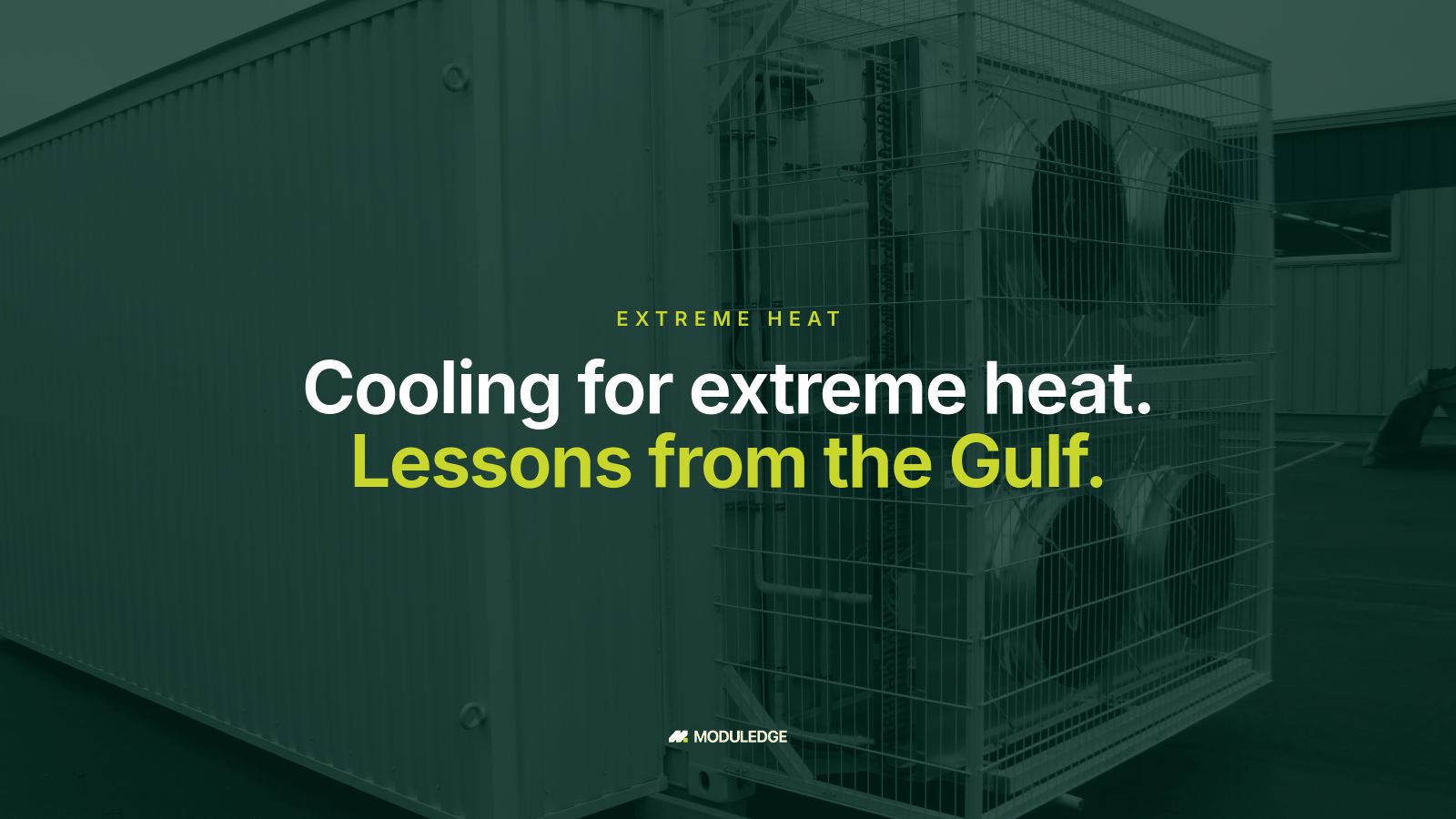
Data center cooling for extreme heat is the practice of matching cooling method to rack density and ambient conditions instead of applying one cooling standard across an entire facility. Legacy air-cooled sites in the Gulf run at a power usage effectiveness (PUE) above 1.8, well past the global average of 1.54 reported by the Uptime Institute’s 2025 Global Data Center Survey. Hyperscale fleets prove the ceiling is much lower: Google reported a 1.09 fleet average for 2024, and Meta reported 1.08. Closing that 0.7-point gap in 45°C ambient takes liquid cooling, indirect evaporative systems, dust filtration, and zoned architecture working together — not one silver-bullet technology.
This post covers why the standard cooling playbook fails above 45°C, what multi-zone cooling architecture actually means, how liquid and adiabatic systems perform at Gulf ambient conditions, the water-energy trade-off operators face in a desalinated-water economy, the desert-specific facility changes that matter beyond the chiller plant, and why factory-built modular is the easier chassis to climate-tune.
Why does extreme heat break the standard data center cooling playbook?
Most operators still spec a Gulf facility the way they’d spec one in Frankfurt. Chilled-water loop, standard containment, one cooling tier applied uniformly across the white space. That’s the mistake.
Free cooling, pulling in outside air to offset mechanical chiller load, is the backbone of efficient design in temperate Europe. It works because ambient air spends much of the year below the temperature IT equipment needs. In Dubai, Riyadh, or Doha, summer ambient regularly clears 45°C, and there are no “free” hours left to harvest. Every watt of cooling has to come from mechanical compression, and every watt of mechanical compression shows up in the PUE line.
The data shows it. Regional market analysis from Emirates NBD Research (2025) puts the average Middle East data center PUE near 1.79, with legacy air-cooled sites running north of 1.8 — worse than the 1.54 global average the Uptime Institute’s 2025 Global Data Center Survey recorded across more than 800 respondents, and dramatically worse than what hyperscale operators publish for their own fleets.
One caveat before that table gets quoted in a board deck: 1.09 didn’t happen in 45°C ambient. Google and Meta operate global fleets weighted heavily toward temperate and cold-climate sites where free cooling does most of the work. Nobody has published a verified 1.09 in Dubai. What the table does show is the achievable range: 1.10 to 1.15 for hyperscale design discipline, under 1.5 for new-build Gulf facilities investing in liquid cooling now. The gap between 1.8 and 1.5 is where the design decisions in this post live.
What is multi-zone cooling architecture, and how does it fix the mismatch?
Multi-zone cooling architecture segments a facility by rack power density instead of cooling every rack to the same standard. AFCOM’s density categories are the industry’s rough shorthand: low density under 4 kW per rack, mid density 5–8 kW, high density 9–15 kW, and ultra-high density at 16 kW and above. A single air-handling design tuned for 5 kW racks will either starve a 40 kW AI inference rack of airflow or waste enormous energy over-cooling a room where most racks don’t need it.
The fix is to stop treating the data hall as one thermal zone. A well-designed facility in high-ambient conditions typically runs three tiers side by side: an air-cooled or free-cooling-assisted zone for storage and low-density enterprise racks, a direct liquid-cooled zone for high-density compute, and an immersion or hybrid zone reserved for the densest AI inference clusters. Each zone gets its own containment and its own cooling loop. Redundancy diverges too, which is where per-zone chiller staging earns its keep: a zone running liquid cooling for 40+ kW racks can’t tolerate the same failover assumptions as the 5 kW air-cooled zone next door.
This is also where modular design has a structural advantage over a poured-concrete build. A module is, by definition, a defined thermal boundary. Stacking three cooling tiers inside one open hall means retrofitting containment walls and rebalancing airflow after the fact. Stacking three modules, each pre-built around a specific rack density and cooling method, means the zoning already exists on day one. ModulEdge’s own module architecture reflects this: air-cooled and free-cooling modules for lower-density racks, liquid-cooled modules for AI inference workloads at 40 kW per rack and above, each designed to meet Tier III/IV principles independently rather than inheriting one building-wide cooling assumption. For more on how that maps to power redundancy across zones, see ModulEdge’s guide to modular data center power architecture and N+1/2N redundancy.
Dubai’s Moro Hub Green Data Centre, the Guinness World Records holder for the largest solar-powered data center, shows this zoning logic running in production. Built on a prefabricated modular design and powered entirely by the Mohammed bin Rashid Al Maktoum Solar Park, the facility uses aisle containment to keep hot and cold air paths separated module by module rather than across one shared hall, with cooling tuned per module instead of to a single room-wide setpoint. It’s the same principle this section describes, just proven at 100 MW scale: contain the thermal problem at the module boundary, and don’t spend energy cooling space that was never generating heat in the first place.
How do liquid cooling and adiabatic evaporative systems perform in extreme heat above 45°C?
Air cooling has a hard physical ceiling. Above roughly 15–20 kW per rack, moving enough air to carry away heat becomes its own energy problem. At 45°C ambient, the air you’re moving is already hot. Direct-to-chip liquid cooling sidesteps the issue by carrying heat away in a coolant loop instead of air, and it does it with far less energy per watt of heat removed.
The regional market is already moving this way. Chilled-water systems still hold roughly a 50% share of UAE data center cooling and wider Middle East deployments, but direct liquid cooling is growing at a 32.5% compound annual rate through 2030, the fastest growth of any cooling category in the region. Two named projects show what that looks like on the ground: HPE and Khazna Data Centers launched a direct liquid-cooled facility for AI workloads in Abu Dhabi in 2024, and Shell, ICS Arabia, and XDS are building two 10 MW immersion-cooled facilities in Riyadh and Jeddah under a 15-year operating agreement, targeting completion by Q4 2026.
Where air still handles lower-density zones, indirect and adiabatic evaporative cooling does the work that mechanical chillers would otherwise carry alone. Adiabatic systems spray or trickle water into the intake air stream, cooling it before it reaches the coil, and during peak summer conditions that can cut electricity use by 10–35% compared with a pure mechanical air-cooled system, according to industry cooling-engineering analysis and Uptime Institute reporting on hot-arid climates. The catch is water. Every liter evaporated to cool the air is a liter that doesn’t come back, and in a desalinated-water economy, that’s not a footnote — it’s the next design decision.
For a deeper look at where direct-to-chip and immersion sit relative to air and hybrid free-cooling designs, see ModulEdge’s guide to liquid cooling for data centers and the companion piece on free cooling, DX, and hybrid cooling architecture.
Water or energy: how do you manage the trade-off in a water-scarce region?
Cooling in the desert forces a choice most European deployments never have to make. Save water and your electricity draw climbs. Save electricity and your water draw climbs. A 2022 case study in Science of the Total Environment on data center water-energy trade-offs in hot-arid climates found this relationship holds consistently: optimizing a facility purely for energy efficiency tends to worsen its water footprint, and vice versa. There’s no cooling configuration that minimizes both at once.
In the Gulf, that trade-off carries a specific cost. Desalinated water runs roughly $5–8 per 1,000 gallons in the region, it’s energy-intensive to produce, and there’s no natural groundwater cushion behind the supply system. Adiabatic spray systems using conventional open loops consume the most water for the energy they save. Switching to trickle-media adiabatic systems can cut that water draw by half or more for equivalent cooling capacity. Direct-to-chip and immersion liquid cooling go further still: closed coolant loops that barely evaporate anything, cutting water consumption by 20–90% relative to conventional air cooling while also reducing facility power draw.
So the practical answer for most Gulf deployments is to zone the trade-off the same way you zone rack density. Reserve adiabatic evaporative assist for the lower-density zones where the water cost is modest, and push every high-density rack onto a closed liquid loop where water consumption approaches zero. ModulEdge’s breakdown of AI infrastructure water usage covers the sizing math in more depth, and the broader efficiency math sits in the PUE data center guide.
What desert-specific facility changes matter beyond the cooling loop?
Cooling technology gets the attention, but three other design decisions determine whether a Gulf facility actually holds its numbers through a summer.
Dust and sand filtration is the one operators underestimate most. GCC data centers pull outside air laden with fine PM2.5 and PM1.0 particulate and, near the coast, salt-laden humidity that accelerates corrosion on any exposed metal. A single-stage filter clogs fast in these conditions, and a clogged filter raises fan static pressure, which raises energy draw, which raises PUE: the exact number the extra filtration was supposed to protect. The fix industry engineering guidance converges on is multi-stage filtration, coarse pre-filters ahead of high-efficiency particulate media, with gas-phase filtration added wherever chemical or salt exposure is heaviest.
Then there’s chiller staging. It matters more in extreme ambient than in temperate climates, because a chiller failure at 45°C doesn’t give an operator the several-hours buffer that cooler ambient air provides elsewhere. Facilities built for Gulf conditions typically stage N+1 or 2N chiller capacity per zone rather than per building, so a failure in the liquid-cooled AI zone doesn’t force load-shedding in the air-cooled zone next to it.
And structural design changes with climate, too. Higher-capacity roof insulation and shaded intake louvers are now standard line items in regional facility specs, along with elevated equipment placement where low-lying Gulf sites carry flash-flood risk. None of these are upgrades bolted on after the fact. The same underlying principles apply outside the desert. High-humidity coastal sites trade sand filtration for corrosion-resistant coatings and dehumidification load. High-altitude sites need derated fan and chiller capacity because thinner air moves less heat per cubic meter. The mechanism changes; the discipline of matching facility design to the specific climate stressor doesn’t.
Why is factory-built modular easier to climate-tune for extreme heat than a poured-concrete legacy build?
A traditional data center is designed once, on paper, months before ground breaks. Its cooling assumptions are frozen the day the concrete cures. Retrofitting a poured-concrete facility for a different climate zone means new containment, new ductwork, sometimes new structural load calculations. That’s slow, and it’s expensive.
A factory-built module starts from a different baseline. The cooling system, containment, and airflow path are engineered, assembled, and tested in a controlled factory environment before the module ever reaches the site. Climate-specific variables like humidity load and dust exposure, along with the evaporative water strategy, get built into the design spec from day one rather than reverse-engineered on location. Deployment timelines compress accordingly. Modular builds run in months, categorically faster than the multi-year timelines typical of traditional construction, because the variable that usually causes delay (site-specific construction and commissioning) is replaced by factory assembly and site integration.
That speed doesn’t come at the cost of design rigor. Each module can still be engineered to meet Tier III/IV principles for redundancy and uptime, with the added benefit that a multi-zone strategy ships as a defined architecture instead of a retrofit plan: air-cooled modules for lower-density racks, liquid-cooled modules for the 40 kW-plus AI inference racks. For the fundamentals of how modular design compares with traditional and containerized builds more broadly, see ModulEdge’s modular data center guide and the piece on building resilience into modular infrastructure.
None of this makes extreme-climate deployment simple. It makes it solvable, with a known set of levers applied in a known order, instead of a single unverified number promising more than the physics of a 45°C summer will actually deliver. Liquid cooling in desert data centers, zoned by density and staged with the right chiller redundancy, is what moves PUE in extreme climates from “aspirational” to “built.”
Frequently Asked Questions
What PUE can a data center realistically achieve in 45°C ambient temperatures?
There’s no verified case of a hyperscale-grade 1.09–1.15 PUE running at sustained 45°C ambient. Those figures come from global fleets weighted toward temperate climates. New-build Gulf facilities investing in liquid cooling and multi-zone design are targeting and reporting figures under 1.5, per Emirates NBD Research (2025), down from a legacy regional average near 1.8.
Why do air-cooled data centers perform poorly in the Gulf?
Air cooling and free cooling both rely on ambient air being cool enough to absorb heat without heavy mechanical assistance. When summer ambient regularly exceeds 45°C, there are effectively no free-cooling hours left, so every watt of heat rejection comes from mechanical chillers. That’s the reason legacy air-cooled Gulf sites report PUE above 1.8 (Emirates NBD Research, 2025).
What is multi-zone cooling architecture in a data center?
It’s a design approach that segments a facility into separate thermal zones by rack power density (typically low, mid, high, and ultra-high density per AFCOM’s classification). Each zone then gets the cooling method it actually needs, rather than one air-handling standard applied across racks ranging from 4 kW to 40 kW-plus.
Does liquid cooling work in extreme heat climates like the UAE or Saudi Arabia?
Yes. Direct-to-chip and immersion liquid cooling move heat through a coolant loop instead of air, which is largely independent of ambient temperature. Named projects already running or under construction include an HPE/Khazna Data Centers direct liquid-cooled AI facility in the UAE (2024) and Shell/ICS Arabia’s two 10 MW immersion-cooled facilities in Saudi Arabia targeting completion by Q4 2026.
How much water does evaporative cooling use in a water-scarce region?
It varies by system design. Conventional open-loop adiabatic spray systems use the most water for the energy they save; trickle-media adiabatic systems can cut that consumption by half or more for equivalent cooling capacity. Closed-loop liquid cooling reduces water use by 20–90% relative to air cooling because it barely evaporates anything.
What is the Dubai Universal Blueprint for AI, and does it set a specific PUE requirement?
The Dubai Universal Blueprint for AI, launched in 2024 as part of the Dubai Economic Agenda D33, is a roadmap to accelerate AI adoption across Dubai’s public and private sectors. Its official government page does not publish a specific numeric PUE mandate. The broader market pressure toward sub-1.5 PUE liquid-cooled facilities in the UAE comes from regional efficiency and sustainability targets tracked by analysts such as Emirates NBD Research, not a single blueprint clause.
Do these desert cooling principles apply to other extreme climates?
They carry over, with the specific mechanism adjusted. High-humidity coastal sites trade sand filtration for corrosion protection and dehumidification load, while high-altitude sites need derated fan and chiller capacity because thinner air carries less heat per volume. The underlying discipline, zoning cooling method to actual thermal stress instead of a single facility-wide standard, applies to every extreme-climate deployment.
Why does factory-built modular design help with extreme-climate cooling specifically?
Dust exposure, humidity load, evaporative water strategy, and rack-density zoning can all be engineered into the module spec before it ever leaves the factory, rather than retrofitted into a poured-concrete building after commissioning. That also compresses deployment timelines to months rather than the multi-year cycle typical of traditional construction.
